



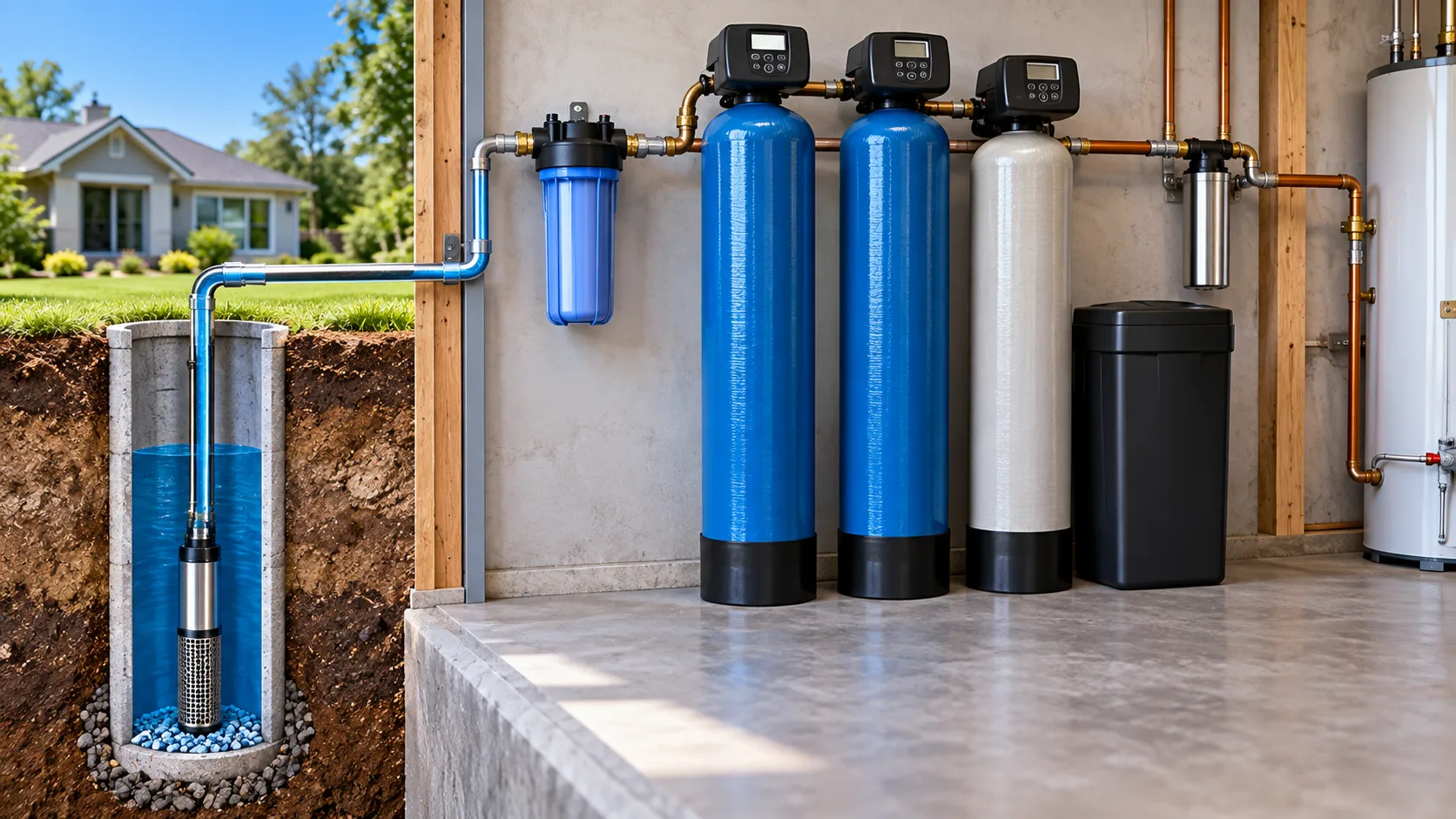
As far as homeowners who have a private well go, the responsibility for water quality is fully up to you. While city water is treated in advance by the authorities, well water is extracted straight from underground water beds.
A well water filtration system helps you deal with this problem. Setting up a complete system for water filtration would cost you between $3,000 and $8,000, while a system that treats a particular problem will cost you a minimum of $500.
This guide tells you about the contaminants in your water, which system treats what, the correct order of installation, its cost, and maintenance.
Quick Answer
A good well water filter system is a chain of filter devices set up in the primary water line of your home to purify the water coming out of all your faucets. Since your well is not regulated by the EPA, you have to treat the water yourself. Single filter systems can be purchased for $500-$1,500. Whole house filter systems cost $3,000-$8,000.
What Is a Well Water Filtration System?
A good water filtration system for wells is a series of filters that are attached to where the water pipe comes into your house. All taps, showers, and appliances get filtered water.
Most houses require multiple stages because one filter cannot clean the water from sediment, iron, acidity, and bacteria. Each of these requires a separate filter. That is why a good domestic water filter system consists of a series of filters, each serving a single purpose.
Why Do You Need a Water Well Filter System?
Raw water coming from an untreated well deteriorates your plumbing system and causes your family to get sick.
Acidic water corrodes your copper plumbing. Iron and sediments will plug up fixtures and ruin appliances. The bacteria caused by septic systems’ failure or farm runoff could infect your well without altering the appearance or odor of the water.
A well filtration system prevents the corrosion of your plumbing, prevents the clogging of your appliances and eliminates any bacteria that might cause illnesses.
The third benefit is the most important one. Polluted water appears clean and has no unpleasant odor or flavor. You should test the water from your well.
1. How to Test Your Well Water in Georgia?
Tests cost a small portion of what the equipment will save you money on, or what you would otherwise have to purchase. Don’t buy equipment based on assumptions.
Where to Test & Cost:
- UGA Extension County Offices: The county office of UGA Extension provides certified well water testing services in Georgia. A basic test costs between $ 40 and $ 60, and a full panel test costs from $ 100 to $ 200.
- State Certified Labs: Best choice for advanced testing of chemicals, heavy metals, and pesticides.
- Home Test Strips: Recommended for estimating pH, hardness, and iron, but unable to test for bacteria, arsenic, and lead.
How to Collect the Sample:
- Disassemble the aerator or filter from the inside tap used for kitchen or bathroom cold water (never use the outside garden hose tap).
- Allow the cold water to flow for 2-3 minutes to clean the pipes.
- Fill the sterilized collection bottle provided by the laboratory without touching the inner side of the lid.
- Bring your samples of bacteria to the laboratory within 24 hours while keeping the collection bottle on ice.
2. Sizing the System: Flow Rate (GPM)
Undersized water filters will starve your water fixtures, whereas oversized ones are costly. House filtration systems are measured by Gallons Per Minute (GPM):
- 1 – 2 Bathrooms: 7 to 10 GPM
- 3 Bathrooms: 10 to 12 GPM
- 4+ Bathrooms: 12 to 15+ GPM
Expert Tip: It is always recommended that you make sure that the filtration system’s GPM rate matches your pump’s capacity. A higher GPM-rated filtration system offers nothing extra beyond your pump’s capacity.
3. Pressure Drop Warning
All stages contribute to increased resistance. The multi-stage filtering system usually reduces house water pressure by 5 to 15 PSI, while a dirty and uncleaned sediment filter reduces it even further.
Well pumps usually work under a 40/60 PSI pressure switch, which turns on at 40 PSI and switches off at 60 PSI. A loss of 10 PSI due to your filter system makes your second-floor showers very weak. Before you install your filters, it’s better to consult your plumber about the static pressure in your house.
4. What Your Home Needs: Space, Drain & Electricity
Prior to purchasing equipment, ensure that your home meets the following physical requirements:
- Floor & Wall Area: A multi-tank system requires 6-8 feet of wall area in a garage, basement, or utility room located close to the entry point for the well line.
- Drainage: A backwashing tank (softener/iron filter) requires the discharge of wastewater into a nearby floor drain, standpipe, or sump pit.
- Power Supply: Electronic valves and ultraviolet water purifiers require dedicated 120-volt power outlets.
5. Bacteria Caution: Retest Before Buying a UV System
A positive test for coliform bacteria doesn’t necessarily mean that you require a costly UV purification system. The coliform bacteria usually make their way into your home via a structural defect in the well.
Things to do before investing in equipment:
- Check for any holes or weaknesses in the structure of your well cap.
- Make sure that there is proper slope to the ground around the well cap.
- Check for setback distances of your septic drain field.
- Shock chlorinate your well system and have a re-test once the chlorine has dissipated.
If the retest comes back clean and stays clean, the structural entry point was the issue. If bacteria returns, a whole-home UV system is the right long-term solution.
6. Dissolved Iron vs. Iron Bacteria
- Dissolved Iron (Red Clay Soil): Clear water that turns reddish-brown after exposure to air. It leaves rust stains on fixtures but does not create slime. Treated using an Air Injection Oxidation (AIO) filter or manganese greensand.
- Iron Bacteria: A living organism that feeds on iron. It leaves a slimy, gelatinous reddish-brown sludge in toilet tanks and produces a swampy or musty odor. An oxidation filter alone will not fix it; it requires well shock chlorination and continuous chlorination feed systems.
7. Removing Tannins & Arsenic in Georgia Wells
- Tannins: Decaying organic matter creates a yellow or tea-colored tint in wells near wooded or low-lying land. Neither sediment filters nor standard water softeners remove tannins. They require a specialized tannin filter using anion exchange resin.
- Arsenic: Occurs naturally in rural Georgia soils. It is completely odorless, tasteless, and colorless. Whole-house removal uses iron-oxide adsorptive media, but installing an under-sink Reverse Osmosis (RO) system at the primary drinking faucet is the most practical and cost-effective choice for most homes.
8. Annual Maintenance Cost Breakdown
Budgeting for annual filter replacements prevents unexpected failure and keeps your system performing properly:
- Sediment Cartridges (Every 3–6 Months): $30 – $100 / year
- Carbon Cartridges (Every 12 Months): $50 – $150 / year
- UV Lamp & Quartz Sleeve (Every 12 Months): $100 – $200 / year
- Water Softener Salt: $60 – $150 / year
- Annual Water Test: $50 – $150 / year
- Total Estimated Annual Cost: $150 – $500 / year
9. Already Bought a System Online?
Many homeowners purchase equipment online from brands like SpringWell or Aquasana before reaching out to a local installer. The Plumb Hero offers installation for customer-supplied equipment.
We will mount your tanks, alter the main plumbing supply, install proper bypass loops, connect backwash drain lines, and confirm that your purchased system matches your actual water chemistry test results.
What Is Filtered Water and How Is It Different From Purified Water?
Filtered water is not the same as purified water.
Filtered water: has gone through a physical substance such as carbon, a sediment filter, or special filters that can trap particles and eliminate bad smells and flavors.
Purified water: is more advanced than filtered water. The water purifier eliminates bacteria, viruses, and dissolved solids at a micro level by means of UV light or reverse osmosis.
Most homes with wells need both: filtration for the whole house, and purification at the tap where you drink.
Types of Well Water Filtration Systems
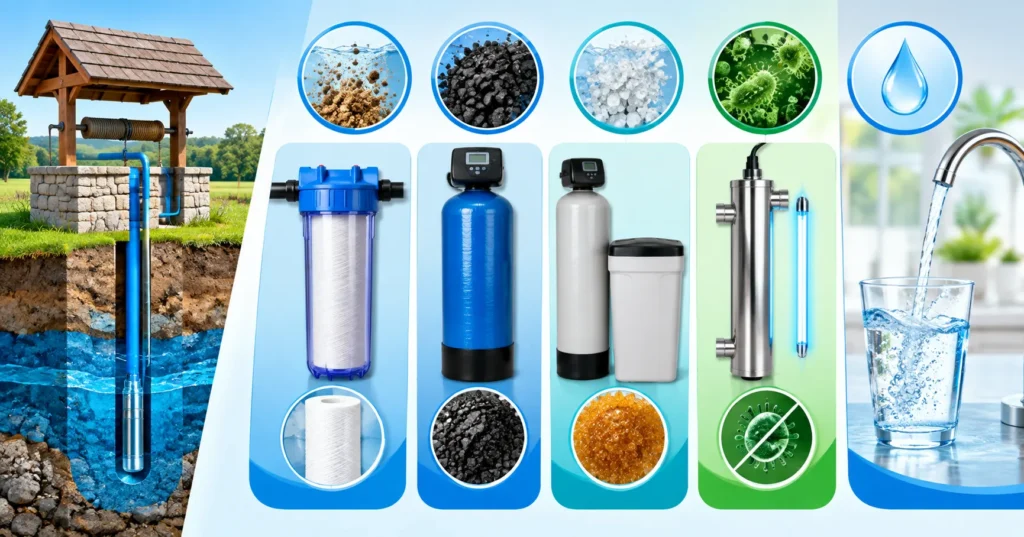
Various contaminants require various treatments. Below is how each works, its cost to install, and when it’s needed.
Sediment filter – $200 to $600:
Catches dirt, sand, silt, and rust flakes before they reach the rest of your plumbing. This is the first stage in almost every system because it protects everything after it from clogging.
Iron and manganese filter – $1,200 to $2,500:
Oxidation is the process used to change dissolved iron and manganese into solid particles that can be trapped in the filter. The two common types of these filters are the air-injection oxidizing filter and the manganese greensand filter.
Acid neutralizer – $1,000 to $2,000:
Raises the pH of acidic water so it stops corroding your pipes and pulling copper and lead into your water. Important for wells in metro Atlanta and the Piedmont.
Water softener – $1,200 to $3,500:
Not a filter. A softener swaps hardness minerals calcium and magnesium for sodium. It does not remove contaminants, but it stops scales from building up in your water heater and pipes, and it lets soap work properly.
Carbon filter – $1,000 to $2,500:
Removes any chemicals, pesticides, and taste and odor that remain after the other processes. This comes after the softening process, as iron and hard minerals make the carbon medium ineffective.
UV purifier – $500 to $1,500:
UV radiation can destroy bacteria, viruses, and parasites without the use of chemicals. UV radiation will only work in clear water because sediment and iron will block the light rays. For this reason, UV is always done last because everything else must be removed first.
Reverse osmosis system – $300 to $800 (under-sink):
Pushes water through a membrane that removes up to 99% of dissolved solids, including arsenic and lead. RO is almost always installed under one sink, not for the whole house. Whole-home RO is expensive and wastes several gallons for every gallon it makes. Most homes put RO at the kitchen tap for drinking and cooking.
Prices are typical installed ranges for the Atlanta area. Your cost depends on home size, water chemistry, and plumbing layout.
How to Choose the Best Water Filter for Whole House Well Water
Picking the best water filter for whole house use starts with knowing what is actually in your water.
Test Your Well Water First:
A lab test tells you which contaminants you have and at what levels. Buying equipment before testing means guessing. You will likely pay for treatment you do not need and miss the problem you do have.
Identify the system according to your contamination:
If your testing indicates elevated iron but low pH, you will require an iron filter and acid neutralizer. An off-the-shelf whole-house water filtration system will not address either problem.
Flow Rate vs. Home Size:
The systems are measured in gallons per minute. A three-bathroom house that uses a shower as well as laundry simultaneously requires a higher flow rate compared to a household of two people.
Keep your expectations realistic:
The ones that can solve your one problem cost $ 500 to $ 1,500, whereas the ones that can solve all your problems cost $ 3,000 to $ 8,000. Do not forget to mention the yearly maintenance filters, UV lamps, and softeners.
Want the right system the first time? Plumb Hero tests your water, explains the results in plain language, and quotes only what your water actually needs.
Call (470) 602-9246 or Schedule Your Free Water Test
Home Water Filter System Installation: The Correct Order
The order of the stages decides whether your system works or fails early. Each stage protects the one after it.
Get the order wrong, and you will replace filters far more often than you should. Carbon placed before a softener, for example, clogs with iron and hardness within months.
Step-by-Step Installation Order for Well Water Systems
- Pre-filter for sediment: Debris removed first to prevent clogging later.
- Pre-filter for acid neutralization: pH corrected first, before water gets to metallic components.
- Iron and manganese removal: Debris removed before it clogs the water softener and carbon filtration media.
- Water softener: Removes calcium and magnesium.
- Carbon filtration: Works with cleaner and softer water.
- UV purification: Final step where purification is done on clean water to kill all organisms.
- Reverse osmosis (optional): Separately installed under the kitchen sink.
How to Purify Water at Home With a Well Filtration System
The most reliable way to purify water at home is to treat it at the main line, before it splits off to the rest of the house. That way every tap, shower, and appliance gets the same treated water, not just the one faucet with a filter on it.
A complete setup does three things:
- Filters out sediment, iron, and chemicals
- Softens the water to stop scale buildup
- Purifies with UV to kill bacteria and viruses
Pitcher filters and faucet attachments only treat the water passing through them. On a private well, they do not protect your pipes, your water heater, or the water you shower in.
Water Filtration Maintenance: How to Keep Your System Running
Proper maintenance of your water filter system prevents you from becoming part of the problem. Clogged filters will lower your water pressure, and an unmaintained system may develop bacteria within it.
Sediment cartridges – every 3 to 6 months: This is where they fill up the quickest. Replace them before water pressure becomes low.
Carbon cartridges – once a year: Worn-out carbon stops absorbing contaminants and may start releasing everything it has absorbed into the water.
UV Lamp Replacement: The UV light continues to glow but stops destroying bacteria. Replace the lamp once a year no matter how it functions.
Media tanks – every 3 to 5 years: Iron filter beds, neutralizer media, and softener resin beds will last several years if properly backwashed.
System Flushing and Backwashing: Set up automatic flushing of the control valves, and check if they are functioning. Silent failure of a control valve allows an accumulation of iron and debris in the media tank.
Water test – once a year: Checks the performance of the system and identifies emerging issues.
Frequently Asked Questions
Do I need a whole house water filter if I have well water?
For the most part, yes. No one treats private wells at all, which means that whatever contaminants are found in the water below come straight through into your tap. Water testing will give you an idea of what needs to be done.
How often should I replace my well water filter?
3 to 6 months for sediment cartridges, 12 months for carbon cartridges and UV lamps, and 3 to 5 years for media tanks, depending on your water quality.
What is the best water filter for well water with iron?
Both air injection (AIO) filters and manganese greensand filters perform satisfactorily. The choice depends on your iron concentration and the presence of either manganese or hydrogen sulfide. The water test determines that.
Can I install a well water filtration system myself?
An inline filter is not hard to do yourself. However, whole-house filters are more complicated, involving multiple tanks and the modification of the main water supply pipe with valves and backwashing timers. The latter require a professional plumber and may void your warranty.
How do I know if my well water needs a filtration system?
Dirty sinks or clothes, sulfur or metallic odor, hazy water, or scaling on fixtures are some symptoms. But sometimes the water may seem fine in appearance and flavor but be contaminated. In such situations, only laboratory testing will confirm it.
How much does a well water filtration system cost?
A one-problem filter will cost you from $500 to $1,500 to install. A multiple-filter system will cost you anywhere between $3,000 and $8,000. The test
How often should I test my well water in Georgia?
The recommendations from the Department of Public Health of Georgia include conducting a bacteria test each year and a full chemical test every three years. Tests should also be conducted after well repair and during periods of flooding.
Get Your Well Water Tested: Call Plumb Hero
You cannot fix a water problem you have not identified. Whether you are dealing with stains, a bad smell, or you want to know what your family is drinking, the first step is the same: a well water filtration system.
Plumb Hero tests your well water, explains the results, and recommends only the treatment your water actually needs.
Call (470) 602-9246 or Schedule Your Free Water Test
