



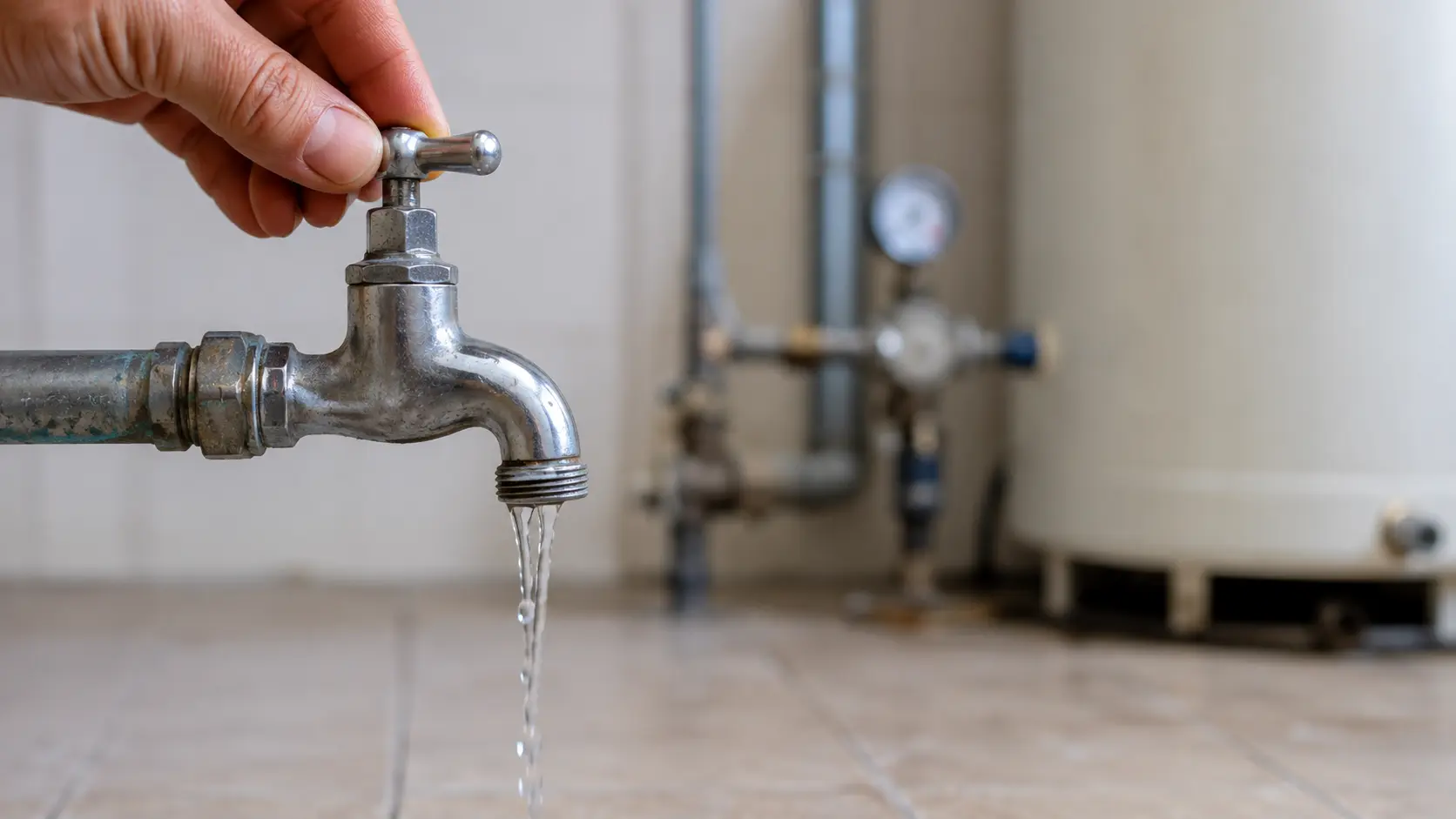
Finding the cause of low water pressure in your house starts with one simple question: Where is it happening?
If there is low water pressure in a house and there is just one faucet in your home, then it is that faucet which has the problem. If there is low pressure throughout your house, then there is a problem with your main supply line, pressure regulator, or plumbing pipes. If it is only your hot water, then there is a problem with your water heater.
Step One: Narrow It Down by Location
Walk the house and open fixtures: kitchen, bathrooms, laundry, and outdoor spigots. Test hot and cold separately at each one.
| What You Find | Where the Problem Is |
| One faucet or shower is weak | That fixture |
| Every fixture is weak | Supply, main valve, regulator, or pipes |
| Only hot water is weak | Water heater or hot water lines |
| Weak at certain times of day | Municipal demand or a shared line |
| Weak and getting worse over months | Corrosion or mineral buildup |
| Weak suddenly, all at once | Leak, valve, regulator, or utility work |
Two questions finish the narrowing: Did this happen suddenly or gradually? Are your neighbors affected?
A sudden loss of water pressure points to a leak, a closed valve, a failed regulator, or utility work. Gradual decline points to corrosion and scale, which take years. Neighbors affected means the problem is outside your property line.
Causes of Low Water Pressure by Area
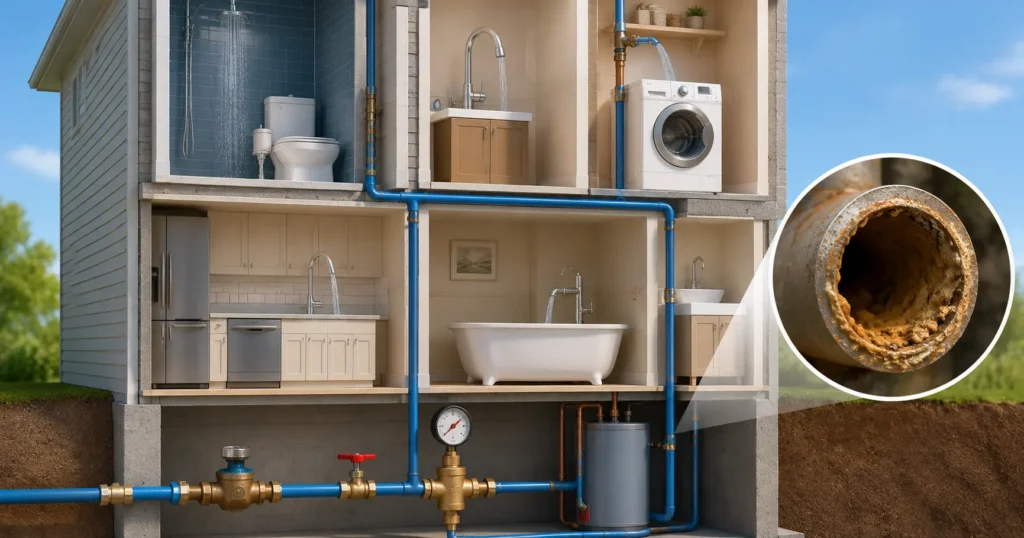
When the low pressure only occurs in one area of your house, it is usually a problem that occurs just at that particular tap and not further upstream in the pipes.
One Fixture Only
The fix here is usually cheap and usually yours to do:
- Clogged aerator: There is a screen that is present at the tip of the tap which catches debris and buildup of minerals. Just remove the screen, dip it in vinegar for several hours, brush it with a soft brush, rinse it, and reinstall it. This is how to clean a showerhead as well.
- Old faucet cartridge: If the problem does not go away by cleaning the aerator and you have an old faucet, then the cartridge has worn out and is clogged. It can be replaced easily and is cheap.
- Not completely open shutoff valve: Every sink and toilet has a shutoff valve beneath it. If somebody worked on that faucet before, maybe the valve wasn’t opened properly.
Work through those three in order before assuming anything larger.
Low Water Pressure in Whole House (Cold and Hot)
If you’re asking yourself, “Why is my water pressure low at all the faucets?”, here are five possible answers ranked from least expensive to most expensive:
- Main shutoff valve not fully open: Check this first every time. The valve sits where the water line enters your home. A gate valve with a round handle must turn counterclockwise until it stops. A ball valve with a lever must sit parallel to the pipe. After any plumbing work, a partially closed main valve is the single most common cause of whole-house pressure loss, and the fix takes ten seconds.
- Water meter valve: The valve is owned by the utility, and the homeowner has nothing to do with it. In case you notice low water pressure immediately after service was done for your line, contact the water utility and ask them to confirm that the water meter valve is open.
- Water pressure regulator failing: Also called a PRV (pressure reducing valve), this device reduces incoming municipal pressure to a safe level. Is your water pressure regulator failing? When it starts to go, it can stick low, stick high, or fluctuate wildly through the day. Regulators typically last 10 to 15 years. Diagnosis and replacement need a licensed plumber.
- Secret leak: If there is water leakage before the water reaches the plumbing systems of your house, you will have low water pressure in house lines. Indicators that you should be looking out for include an increase in the water bill with no change in consumption, dampness on walls or ceilings, peeling paint, presence of mold, noise of water running, and dampness in the lawn. The secret leak is the only one here that gets worse.
- Rusted or scaled pipes: The rusting and scaling of pipes reduces their inner capacity over the passage of many years. Galvanized iron pipes are typically the cause, starting to rust after about 20 years. Copper pipes usually last 50 years or longer. Signs are the gradual deterioration, rust-stained water, and an old building without repiping ever having been done.
Hot Water Only
Cold flows fine, hot barely moves. That narrows the problem to the water heater or the hot-side lines.
- Minerals in the tank: They settle at the bottom and block the hot water outlet. Usually, a flush of the tank will solve this problem, and an annual flush prevents this.
- Hot water shutoff partly open: The hot water shutoff valve that is at the top of the water heater may not be completely open after servicing.
- Scale in the hot lines: The hot water causes faster scale formation in the pipes compared to the cold water pipes in the same household.
- Aging heater: If flushing changes nothing and the unit is past ten years, the outlet or the internal components may be restricted.
What Normal Water Pressure for a House Actually Is
Numbers matter here more than adjectives.
- 40 to 60 PSI: This is the normal water pressure for a house.
- Below 40 PSI: Considered low water pressure.
- Above 80 PSI: High pressure that damages plumbing over time.
Municipal water pressure varies across Metro Atlanta by elevation and distance from the supply. Homes on higher ground in Gwinnett and North Fulton commonly see lower delivered pressure than homes at lower elevation on the same system.
The high-pressure condition is also as important as the low-pressure condition. Any reading above 80 PSI on the pressure gauge indicates that the life of the water heater will be reduced, the T & P relief valves are open, the supply pipes to washing machines and toilets are under stress, and certain appliance warranties are voided.
What Not to Do?
Three things homeowners try that make the situation worse:
- Do not adjust the pressure regulator without a gauge on the system. Turning the screw blind can push household pressure past 80 PSI, which trades a nuisance for pipe and appliance damage.
- You should not be installing a booster pump before knowing the problem you have to solve. Booster pumps cover up the problem, increase the pressure on your already corroded pipes, and cost money for no gain. They are useful when there is really a shortage from the town.
- Do not ignore a sudden loss of water pressure. Gradual decline is usually wear. A sudden drop with no utility work in the area frequently means a leak, and leaks do not stop on their own.
When to Call a Plumber?
Take care of the following yourself: cleaning aerators and shower heads, opening the main shut-off valve fully, checking the supply valves for fixtures, testing the water pressure, and draining the water heater.
Call a licensed plumber when:
- Pressure is low at every fixture, and the main valve is fully open.
- Your gauge reads below 40 PSI or above 80 PSI.
- You suspect a hidden leak causing low water pressure in house lines.
- Your water pressure regulator is failing and causing fluctuating readings through the day.
- Your water bill rose with no change in usage.
- Water is rust-colored or discolored.
- The home has galvanized steel piping.
- You experience a sudden loss of water pressure with no utility work nearby.
Leak detection in particular needs equipment. Acoustic listening devices and thermal imaging locate a leak inside a wall or under a slab without opening up the house to find it.
Frequently Asked Questions
Why is my water pressure low all of a sudden?
A sudden loss of water pressure throughout the entire house is usually an indication of a partially shut-off main water valve, a malfunctioning pressure regulator, a hidden leak, or city water line service. Begin by checking your main valve, then check with a neighbor.
What is normal water pressure for a house?
The normal water pressure for a house should sit between 40 and 60 PSI. Anything under 40 PSI is low, while readings above 80 PSI can cause severe plumbing damage over time.
Why is my water pressure low in only one faucet?
The problem is isolated to that fixture. Start with the aerator screen, which collects sediment and mineral scale. If cleaning it changes nothing, check the supply valve under the sink, followed by the faucet cartridge.
Can a hidden leak cause low water pressure in whole house systems?
Yes. When water escapes through a leak before reaching your fixtures, flow drops at every outlet. An unaddressed leak will also spike your water bill and risk mold or structural damage.
Why is only my hot water pressure low?
The issue is restricted to the hot side lines. Sediment inside the water heater tank restricting the outlet is the most common cause. A partially closed hot water valve or scaled hot lines are other frequent culprits.
How do I know if my water pressure regulator is failing?
A water pressure regulator failing typically shows up as weak pressure throughout the entire house, pressure that spikes or drops randomly, or water pressure that hums and vibrates in the walls.
Will a booster pump fix low water pressure?
Only when municipal supply pressure is genuinely low. If the cause is a leak, a closed valve, a failed regulator, or corroded pipes, a booster masks the symptom and can worsen pipe damage.
Is a sudden loss of water pressure an emergency?
Not always, but a sudden unexplained drop deserves quick attention. If you also hear water running with every fixture turned off, see damp drywall, or find a spiked water bill, treat it as an emergency leak.
Can hard water cause low water pressure in house piping?
Yes, over time. Dissolved minerals deposit inside pipes, aerators, showerheads, and water heaters, narrowing the pathways water flows through.
How to increase water pressure in the house?
If you are looking at how to increase water pressure, start by fully opening your main shutoff valve and cleaning your faucet aerators. If whole-house pressure measures under 40 PSI on a gauge, you can increase it by adjusting your pressure reducing valve (PRV) or having a plumber install a booster pump for low municipal lines.
Get an Accurate Diagnosis
Having low water pressure in house supply lines is a symptom. The cause ranges from a five-minute aerator cleaning to an active leak inside a wall, and guessing wrong costs money in both directions.
The Plumb Hero diagnoses water pressure problems across Metro Atlanta. We test pressure at the source, inspect your regulator, and use leak detection equipment to find hidden leaks without opening walls.
Call (404) 992-8800 or schedule service online.
