



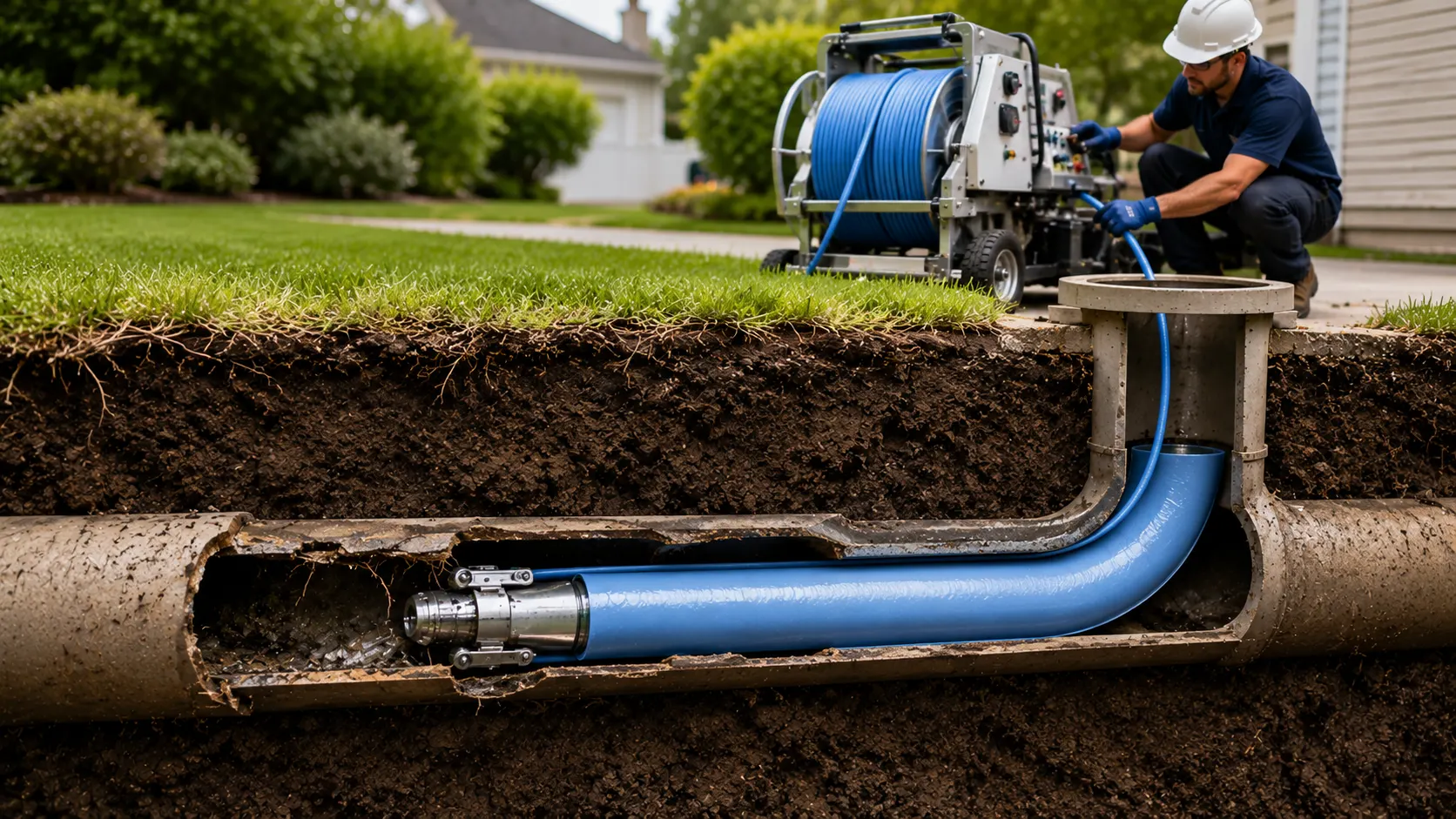
Trenchless sewer line repair involves either repairing or replacing a damaged underground sewer pipe using only one or two small openings rather than digging a trench all along the yard where the pipe is located. There are two ways of doing this. Lining involves lining a new pipe within the existing pipe. Bursting involves breaking up the existing pipe and installing a new one.
Residential jobs typically take only one day and can range anywhere between $2,500 and $15,000. The completed line will last for 50 to 100 years.
This article will help you with everything you need to know about these two options, what makes your pipe eligible or not, the true cons, the financials compared to regular digging, and all the questions you should ask.
Brief Answer: The trenchless sewer line repair process will allow you to repair or even replace your sewer lines without damaging your property, such as your yard, driveway, or any landscaping. Rather than having to tear apart your property, the work is done using one or two small holes in one to two days.
What Is Trenchless Sewer Line Repair?
Trenchless sewer repair relies on the same route taken by the existing pipeline during the repair process. There is digging of just one or two holes, and the repair takes place using the existing sewer pipe, with no damage to your garden, lawn, driveway, patio, or mature trees.
The traditional excavation technique requires excavation of a trench along the entire extent of the damaged pipe.
All materials that exist above the pipe will come out before anything else: concrete, sod, irrigation pipes, gardens, and retaining walls. Trenchless technology is more expensive per foot up front, but the overall cost of the project could end up being equal or even less when you factor in surface restoration costs.
Just replacing a driveway costs anywhere from $1,000 to $5,000. Each project begins with a camera inspection.
The Two Main Trenchless Methods: Pipe Lining vs Pipe Bursting
To determine which is better between pipe lining and pipe bursting, it is important to understand how each technique works.
Pipe lining, also called CIPP lining.
CIPP lining (cured-in-place pipe) saturates a flexible liner with resin, installs it inside the damaged pipe, expands it against the pipe wall, and cures the resin until it hardens. The result is a jointless pipe formed inside the old one.
- Inversion: Air or water pressure turns the liner inside out as it travels down the pipe, pressing resin against the host pipe wall. Works well on longer runs and around bends.
- Pull-in-place: The crew pulls the liner into position with a cable, then inflates a bladder to press it outward. Best for shorter runs and spot repairs.
Curing options include ambient cure (slowest), hot water/steam cure (1–4 hours), and UV cure (under an hour). CIPP lining suits pipes with cracks, corrosion, and root intrusion, provided the host pipe still holds its structural shape.
Pipe bursting
Unlike lining, pipe bursting replaces the line completely. A crew digs a pit at each end of the run, threads a steel cable through the old pipe, and attaches a conical bursting head with a new HDPE pipe trailing behind it.
A hydraulic winch pulls the head through, fracturing the old pipe outward into the surrounding soil while pulling the seamless HDPE pipe directly into the void. Pipe bursting handles pipes too deteriorated to support a liner, as well as situations where you need to upsize a 4-inch line to 6 inches.
Other trenchless options
Descaling and hydro jetting: A prerequisite process for removing roots, scale, and grease prior to lining a pipe.
Point or sectional repair: A limited liner is installed to cover a specific joint or crack rather than the entire length.
Slip lining: A smaller diameter pipe is inserted into the existing pipe (an old technique applied to long sewer lines).
How a Trenchless Sewer Repair Runs
- Inspection and location: The plumber conducts an inspection using a camera to identify the problem areas and location of the pipes.
- Permit: The plumber obtains a required municipal plumbing permit from a licensed contractor.
- Cleaning: The plumber uses either hydro jetting or descaling to remove the roots and other debris from the pipes.
- Second camera pass: Confirms the pipe is clean and takes final measurements.
- Access: One or two 3-to-4-foot pits are dug at access points.
- Installation: The liner cures, or the bursting head pulls the new HDPE pipe through.
- Reinstatement and final inspection: Branch connections are reopened with a cutting robot, a final video pass is completed, and the inspector signs off.
What happens to your plumbing during the job
Plan on no water use for 4 to 8 hours. Toilets, sinks, showers, dishwashers, and washing machines stay off while the line is being serviced. You can stay in the house while the crew works outside.
Does Your Pipe Qualify for Trenchless Repair?
Trenchless pipe repair uses advanced lining or bursting technology to restore underground sewer lines without destroying your yard, driveway, or flooring provided the pipe still maintains its basic structural integrity.
Good candidates for pipe lining:
- Longitudinal or circular cracks with the pipe still holding shape
- Root intrusion at joints or corroded cast iron
- Lines running under a driveway, patio, slab, or mature landscaping
Good candidates for pipe bursting:
- Pipes deteriorated past the point of supporting a liner
- Orangeburg pipes, which deform rather than crack
- Undersized lines needing a diameter increase
Cases requiring traditional excavation:
- Fully collapsed pipe sections with no path for a liner or bursting head
- Severe bellies (sagging sections that hold standing water and ruin slope)
- Lines requiring a complete route change
Trenchless Sewer Repair Pros and Cons
Understanding the trenchless sewer line repair pros and cons ensures you make an informed decision for your property.
Pros
- Your yard survives: Two small pits instead of a torn-up lawn.
- No concrete demolition: Fixes lines under driveways or patios without breaking the slab.
- Speed: Wraps up in 1 day for most residential runs.
- Durability: Materials resist roots and corrosion for 50+ years.
- Better flow: Smooth interior walls improve overall flow capacity.
Cons & Limits
- Not for collapsed pipes: Severe bellies or crushed lines still require digging.
- Higher upfront quote: Equipment and specialized resin materials cost more than raw excavation labor.
- Minor diameter drop: CIPP lining reduces internal diameter by 3% to 8% (though smooth walls offset flow loss).
- Technician skill required: Needs certified installers and robotic reinstatements for branch lines.
Trenchless vs Traditional Sewer Repair
Trenchless repair restores underground pipes using minimal access points, saving thousands in yard restoration, while traditional excavation requires digging up the entire line to replace completely collapsed or severely sagged pipes.
| Feature | Trenchless Sewer Repair | Traditional Excavation |
| Property Disruption | 1 to 2 small access pits | Full-length open trench through yard/driveway |
| Timeline | 1 day for most residential jobs | 2 to 5+ days |
| Plumbing Downtime | 4 to 8 hours | Multiple days without sewer service |
| Quoted Rate (per foot) | $60 to $250 / ft | $50 to $250 / ft |
| Restoration Costs | $0 to minimal | $1,000 to $5,000+ (driveway, sod, patio) |
| Result Lifespan | 50 to 100 years | 30 to 50 years |
When comparing trenchless vs traditional sewer repair, traditional excavation only wins when a pipe is completely collapsed, has severe bellies, or sits shallow in bare dirt with zero restoration costs.
Trenchless Sewer Repair Cost Analysis
When budgeting for a project, total trenchless sewer line repair cost typically ranges between $2,500 and $15,000 depending on length, depth, soil, and technique.
Cost breakdown by item
- Camera inspection: $150 to $450
- Hydro jetting/prep: $350 to $900
- Pipe lining (CIPP): $80 to $250 per linear foot
- Pipe bursting: $60 to $250 per linear foot
- Access pits: $500 to $1,500 each
- Permits: $100 to $500
Real project estimates
- 40-foot shallow lateral (Lining): $4,500 to $8,000
- 60-foot lateral under a driveway (Bursting): $8,000 to $14,000
- 100-foot deep, complex lateral: $15,000+
How Long Does Trenchless Sewer Repair Last?
Epoxy CIPP Liners and HDPE Pipes have a life expectancy of 50 to 100 years with correct installation. The warranties on the materials last from 10 to 50 years, with a workmanship warranty in addition to the materials warranty.
Permits, Insurance, and Questions to Ask
- Permits & Code: Sewer repairs require municipal permits and inspections in order to maintain home resale value.
- Insurance: Standard homeowner’s insurance does not cover wear-and-tear or root damage unless you have a Service Line Endorsement.
Questions to ask your contractor:
- Are you licensed or insured in Georgia, and what is your license number?
- Which method do you recommend based on the camera footage?
- Does the quote include inspection, cleaning, permits, reinstatements, and pit restoration?
- Will you provide before-and-after camera footage for my records?
Indicators That Your Sewer Line Requires Maintenance
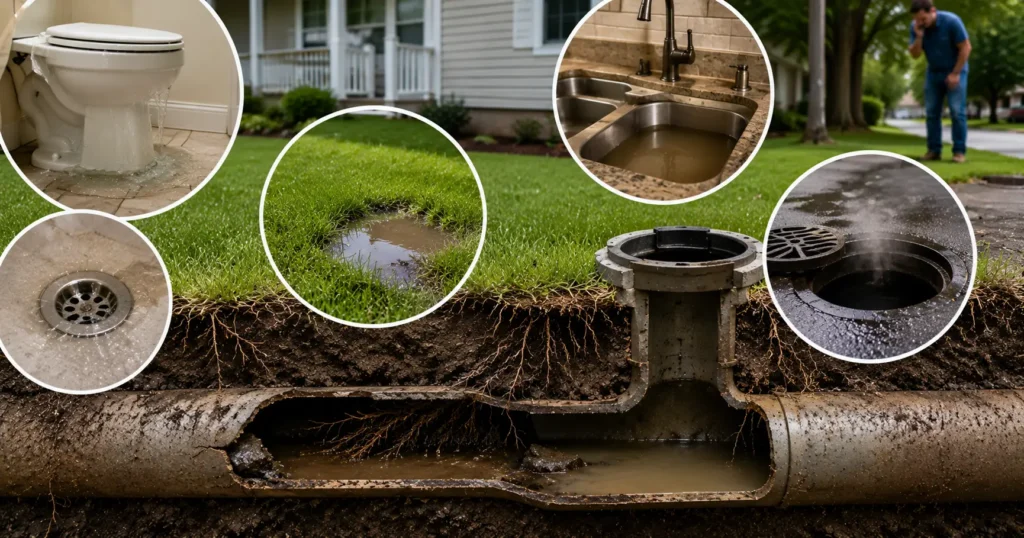
If you experience frequent clogs, toilet gurgling, foul smells from your drains, dark green spots on your lawn, or sinkholes, there is likely a problem with your sewer line that needs to be inspected with a camera.
- Slow Drains Throughout the House: If you have a problem with one faucet, then that’s probably just a localized clog. However, if the drains in your bathroom, shower, and kitchen are all clogged at once, the problem is much more serious; most likely there’s a clog in your sewer lateral.
- Clogs That Just Don’t Go Away: If you’ve unclogged the toilet or the sink, but they clog up again a few days later without any foreign material being flushed down the drain, there is something wrong with your main sewer line. The common problems include root damage, scale build-up, and partial pipe collapse.
- Gurgling Toilets and Bubbles in the Drain: Air that becomes stuck in a clogged main line needs somewhere to go. This is why, if you flush a toilet, the air gets squeezed out of the pipe and comes out through your lowest fixtures, i.e., the tub or shower drain.
- Sewage Odors Either Inside or Outside Your House: An efficient sewer system does not have any leakages. The presence of stinking, foul odors coming out of your drains, basement, or even your yard cleanout is an indication of sewer gas escaping through cracks in the pipe or trap.
- Unusual Greenery in Your Garden: Wastewater has nutrients and nitrogen in it, which serve as a fertilizer for the grass. If you observe some particular green patches of grass in your garden that are greener than others, then there must be leakage in your sewage.
- Sinkholes: With a continuous leakage from the pipe, there occurs erosion of soil and red clay around the pipe. This causes sinkholes to develop in the sewer line, which appear wet and have an unpleasant odor.
Trenchless Sewer Line Repair in Norcross and Metro Atlanta
The Plumb Hero specializes in Trenchless sewer line repair and replacement for residents in Norcross, Duluth, Alpharetta, Johns Creek, Marietta, Decatur, Sandy Springs, Buford, and nearby metro Atlanta areas.
Local conditions shape these jobs. Gwinnett and North Fulton neighborhoods built before 1980 sit on clay laterals with joints every few feet. Georgia red clay soil swells and shrinks through wet and dry cycles, which pulls those joints apart. Mature hardwoods and pines send roots into every separated joint they find. That combination makes lining and bursting a strong fit across most of the metro.
Every project starts with a camera inspection and a written scope tied to the footage. You see the pipe before you approve any work, and you keep the video.
Call (470) 602-9246 or schedule online.
Frequently Asked Questions
Is trenchless sewer line repair worth the cost?
For most homeowners with anything above the pipe, yes. A $9,000 trenchless job competes directly with a $6,500 excavation quote plus $3,000 to $5,000 in concrete and landscaping restoration. Trenchless also finishes in a day instead of a week, and the finished line carries a 50- to 100-year service expectation. If your pipe qualifies, trenchless usually wins on total cost and always wins on disruption.
Which is better, pipe lining or pipe bursting?
Neither is universally better. Pipe lining works when the old pipe still holds shape and costs slightly less per foot. Pipe bursting replaces the pipe entirely, handles worse deterioration, and allows upsizing to a larger diameter. The camera footage decides. Any contractor recommending a method before running a camera is guessing.
Does trenchless sewer repair work under a driveway or concrete slab?
Indeed, and here the procedure gets its value. Both methods use the current pipe, thus leaving the concrete above it intact. The conventional method of digging under a driveway requires drilling and repouring the driveway itself, adding an extra 1,000-5,000 even before any plumber costs.
Does a liner reduce my drain capacity?
Slightly, and the finished flow usually improves anyway. A CIPP liner reduces internal diameter by roughly 3 to 8 percent. The liner wall is smooth, while the pipe it replaced was corroded, scaled, or root-filled. A smooth wall moves more water than a rough one at the same nominal diameter. If your line already runs undersized, pipe bursting with upsizing solves the concern outright.
Does trenchless repair work on a collapsed pipe?
No. A liner needs a host pipe holding its shape, and a bursting head needs a path to travel. A fully collapsed section requires excavation of that section. The rest of the run sometimes still qualifies for trenchless work, which limits the digging to one spot.
Does trenchless sewer repair fix a belly in the line?
No. A belly is a grade problem, and both trenchless methods follow the existing pipe path. Lining over a belly gives you a new pipe still holding water in the same low spot. Correcting the grade requires excavating that section and resetting the slope.
Do I need a permit for trenchless sewer repair?
In nearly every jurisdiction, yes. A licensed contractor pulls the permit and schedules the municipal inspection at completion. Unpermitted sewer work causes problems during a future home sale, and some manufacturer warranties require permit documentation.
How long does the job take, and do I have to leave my house?
Residential jobs usually take one day, with anywhere from four to eight hours of no water being used because of the curing process or the installation of a new pipe. You get to remain in your house during the job. Do your laundry and run your dishwasher the night before.
Does trenchless sewer repair work with a septic system?
Yes. The lateral running from the house to the tank gets lined or burst the same way as a line running to a municipal main. The tank and the drain field are separate systems with separate repair paths.
Does trenchless work on cast iron and clay pipe?
Yes, both. Cast iron with corrosion and wall loss lines well when the pipe still holds shape. Clay with cracked or root-invaded joints is one of the most common lining applications. Orangeburg is the exception, since it deforms rather than cracking, which usually points to pipe bursting.
What happens to the old pipe during pipe bursting?
The bursting head fractures it outward into the surrounding soil, and the fragments stay underground. Nothing gets hauled away. The new HDPE pipe occupies the space the old pipe held.
Does homeowners insurance cover trenchless sewer repair?
Standard policies exclude wear, corrosion, and root damage, which cover most sewer failures. A service line endorsement covers the underground lateral for a modest annual premium. Water backup coverage handles interior damage from a backup rather than the pipe repair.
How do I know a trenchless contractor is qualified?
Ask for the Georgia license number, the number of trenchless jobs the crew has completed, and any manufacturer certification on the lining system they install. Then ask to see before and after camera footage from a recent job. Trenchless work needs specialized equipment and real technique, and installation quality decides whether you get 50 years or a callback.
Is trenchless sewer repair cheaper than traditional excavation?
Per foot, no. In total project cost, usually yes. Excavation quotes rarely include restoring the driveway, sod, irrigation, and landscaping the trench destroys. Add those and the two numbers converge, with trenchless coming out ahead on most properties with hardscaping or mature landscaping above the pipe.
Does a CIPP liner reduce drain capacity?
Minimal internal diameter reduction occurs (roughly 3% to 8%), but hydraulic capacity usually increases. The ultra-smooth resin interior reduces friction compared to corroded cast iron or root-filled clay.
