



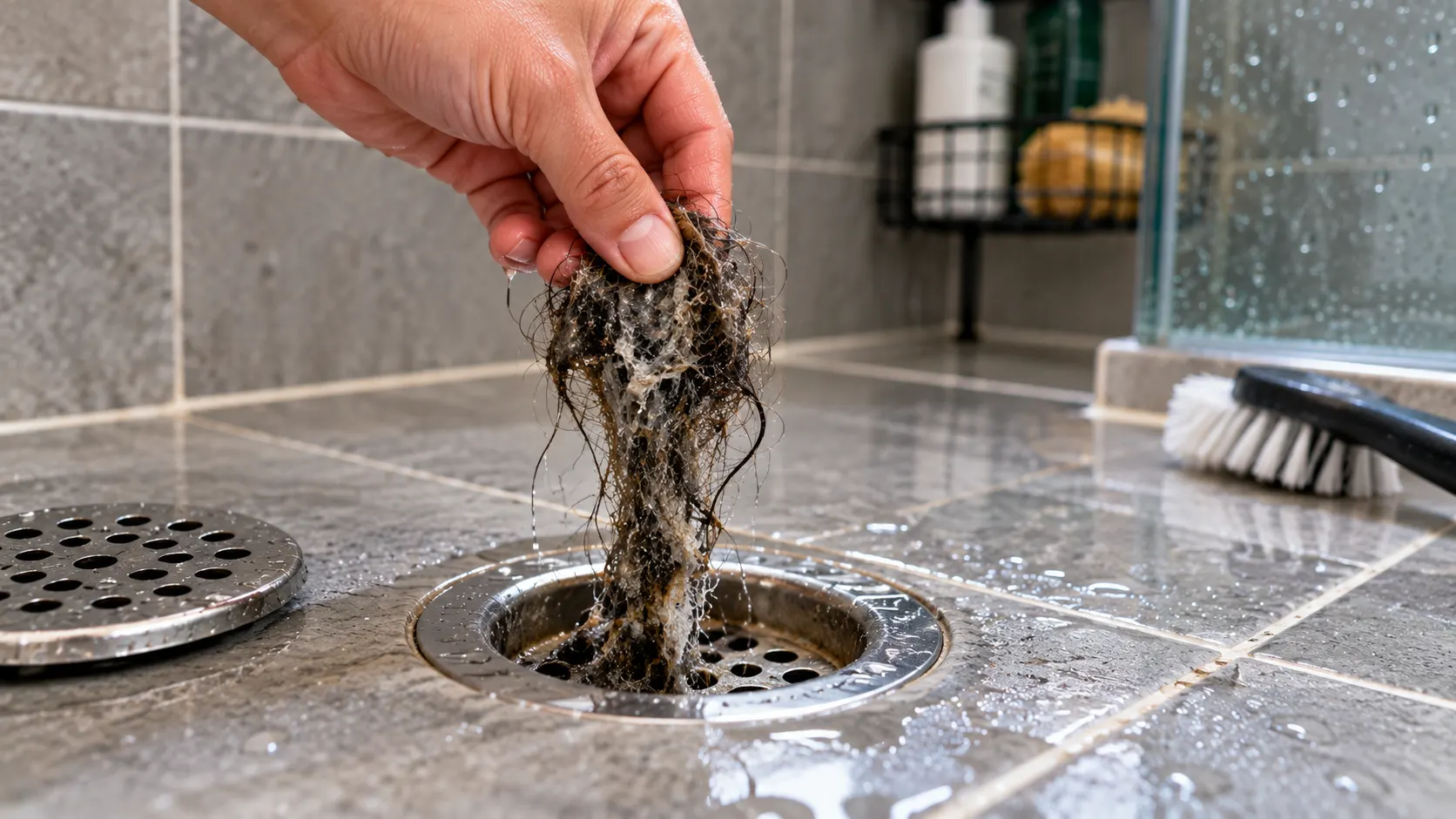
Water pools around your feet before your shower ends. The drain gurgles. By the end of the week, you are standing in three inches of gray water.
Hair is the cause in roughly 9 out of 10 shower drains our plumbers open in Norcross and across Metro Atlanta. Soap scum binds those hair strands into a thick mat that sits within the first 12 inches of the drain, well above the P-trap.
It is location that makes the following ranking important. Knowing the best way to unclog a shower drain system comes down to the knowledge of the method that will get rid of the obstruction without harming the pipes. The obstruction that you can deal with using a two-dollar tool does not require anything else.
Written by The Plumb Hero Team | Licensed Master Plumbers
Quick Answer
The best way to unclog a shower drain is the manual removal of the hair using a flexible plastic hook that has barbs. The clogs in most showers occur at less than 12 inches in the drain, meaning that removing the mat will clear the clog in less than 5 minutes without the need for any chemicals or pipe damage.
The 5 Methods, Ranked
1. Manual Hair Removal, the Method That Clears Most Clogs
- Effectiveness: Highest for hair clogs
- Time: 5 minutes
- Cost: Under $5
- Pipe Risk: None
Shower clogs are physical, not chemical. Nothing dissolves a hair mat reliably. Removing it works, making it the best way to unclog shower drain obstructions.
What you need: A barbed plastic drain auger, rubber gloves, a flashlight, a screwdriver, and a garbage bag.
- Step 1: Remove the drain cover. Some lift out. Some unscrew with a Phillips screwdriver. Some twist counterclockwise.
- Step 2: Aim the flashlight at the entrance to your disposal. In most situations, you will see the mat in arm’s reach.
- Step 3: Pull out whatever you can grab manually, wearing protective gloves.
- Step 4: Insert the spiked device inside until it doesn’t go any further, then pull it back out slowly. The spikes will grab onto the hair while removing it from the disposal. Wipe the device off into the trash bag and repeat until it’s clean.
- Step 5: Run hot tap water for one minute and observe the flow.
- Step 6: Reinstall the cover.
Field Note: The tool needs to come back empty twice in a row before the clog is fully clear. Most people stop after one good pull and wonder why the drain slows again in a fortnight.
2. Drain Snake, for Clogs Past Arm’s Reach
- Effectiveness: High when dealing with deep clogs
- Time required: 15 to 30 minutes
- Cost: $15 to $30
- Risk of damaging the pipe: Low provided that the process is done properly
This is your go-to if the barbed drain cleaning tool returns empty, yet there are still issues with a slow-draining shower drain.
- Step 1: Take off the drain cap.
- Step 2: Insert the cable into the drain until you feel some resistance.
- Step 3: Turn the handle in a clockwise direction while applying gentle forward pressure. The clockwise movement will push the head against the blockage.
- Step 4: Once you have engaged the head, retract the cable slowly, cleaning it as it emerges.
- Step 5: Clean the drain with hot tap water for two minutes.
Important: Do not force the cable. Any resistance which cannot be overcome is normally an indication of a bend or fitting and not an obstruction, and forcing the cable can damage the drain.
3. Plunger, for Soft and Partial Blockages
- Effectiveness: Moderate
- Duration: 5 minutes
- Cost: $10
- Risk to Pipes: None
A cup plunger pushes water around, and water movement moves soft material. It won’t move a compacted shower drain clogged with hair, hence its third place on the list.
- Step 1: First, take out the drain cover so that the plunger will work on the opening instead of the drain cover.
- Step 2: Fill enough water in the shower base to ensure that the rubber cup is submerged in it. There will not be any hydraulic pressure created by a dry seal.
- Step 3: Apply some petroleum jelly at the edge of the cup for a better sealing effect.
- Step 4: Push the cup downward to get rid of the air inside and then plunge for about 20 to 30 seconds.
- Step 5: Move the cup away and look at the drain.
A shower drain does not have an overflow hole. This step is required only in sink or tub draining.
4. Hot Water Flush, for Soap and Grease Only
- Efficiency: Low for hair; medium for soap
- Duration: 5 minutes
- Cost: Free
- Pipe Danger: Medium, if using hot water
Hot water dissolves soap and body oils, but does nothing to dissolve hair.
Ensure that you know what your pipe is made of before using hot water. Pipes that were fitted after 1980 are most likely made of either PVC or ABS. Hot water at 212°F comes close to dissolving PVC.
- For PVC and ABS: Let the hot tap run fully for three to five minutes. It’s fine and safe to use 120 to 140°F water for the purpose of soap.
- For cast iron, galvanized steel, and copper pipes: Pour in two to three liters of water that is boiled in stages, giving a 10-second interval between pours.
Do not attempt this if you have already used any type of chemical cleaners in your drain system.
5. Chemical Drain Cleaner, the Last Resort
- Effectiveness: It varies
- Time Required: 15-30 minutes
- Cost: $8-$15
- Risk to Pipe: The highest among all the options
Use chemicals as your last option after using all other mechanical methods and not willing to contact a plumber. When looking for the best shower drain cleaner, opt for enzyme cleaners first.
Safety rules, all four of which matter:
- Don’t mix products: Mixing two cleaning products together, or mixing a cleaner with bleach or ammonia, causes the release of chlorine and chloramine gas.
- Don’t use the plunging or snaking after a chemical cleaner: The caustic fluid will splash into your skin and eyes. In case the cleaner didn’t work, rinse it off with cold water and inform your plumber about what cleaner you’ve used before opening the line.
- Ventilate: Open a window and turn the bathroom’s fan.
- Stick to dwell time according to the label instructions: Keeping a caustic product inside a pipe all night will damage the pipe and sealant.
The enzyme cleaner is less dangerous. It acts on organic matter over hours, not minutes, making it good for maintenance and useless in emergencies.
Real-World Scenario: “I Installed a Hair Catcher, But the Drain Is Still Slow”
A hair catcher stops new hair from going down. It does nothing to the mat that is already in the pipe.
If water pools during the shower and takes three to five minutes to clear afterward, the existing blockage is still in place. The catcher is preventing the problem from getting worse, not fixing it.
Start at Method 1: Remove the cover, pull the mat out with a barbed tool, and keep going until the tool comes back clean twice in a row. Most drains in this condition clear in one session.
If the water still lingers after that, the remaining blockage sits below the P-trap and needs a snake.
Best Tools to Fix a Clogged Shower Drain
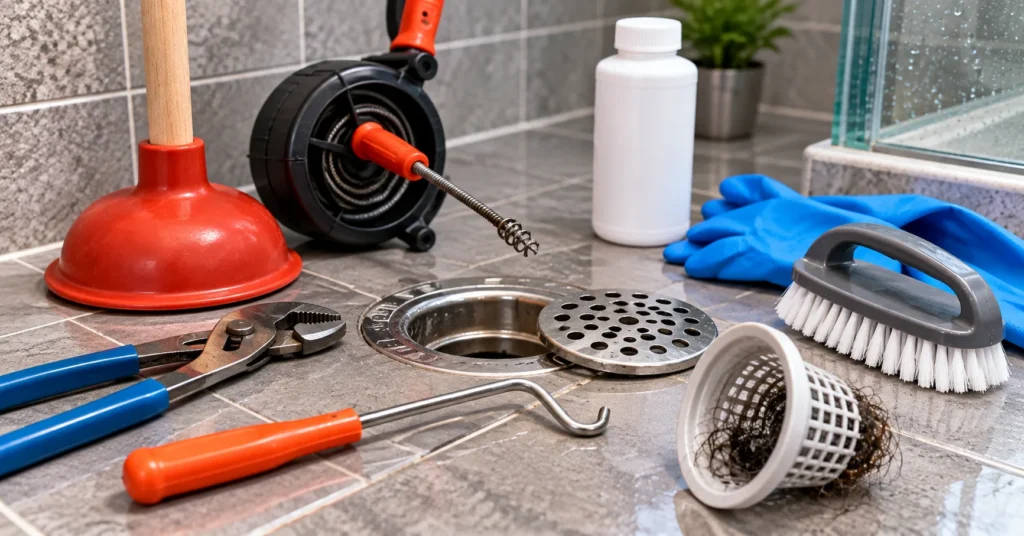
Must-have equipment to fix a shower drain clogged with hair and soap scum without calling a professional.
- Plastic Hair Clog Removal Tool (Zip-It Tool): An inexpensive plastic tool with small prongs that work well to grab hair balls within the first foot.
- Plunger Cup: Best suited for producing high-pressure hydraulic force against soft, flexible clogs.
- Drain Auger (Plumber’s Snake): Steel-cabled tool that is 15 to 25 feet long for clearing deep P-trap and branch line clogs.
- Needle-Nose Pliers: Best for snagging hair that is tightly entangled around the crossbars under the drain screen.
Baking Soda and Vinegar, an Honest Assessment
This combination appears in nearly every article on how to unclog a shower drain naturally. Here is what actually happens.
Baking soda and vinegar react to produce carbon dioxide, water, and sodium acetate. The fizzing is the gas escaping. What remains in your pipe afterward is salt water.
The reaction produces no meaningful force in an open drain, and it does not dissolve hair or break down the soap binding it. What the combination does well is deodorize a drain and loosen light surface residue.
Use it for maintenance. Do not expect it to clear a standing water clog.
We include this because the alternative is telling you something that will not work and letting you find out with three inches of water in your shower.
Comparing Your Options
Quick method-by-method breakdown of cost, time, and pipe risk.
| Method | Best for | Time | Cost | Pipe risk |
| Manual hair removal | Hair mats near the drain | 5 minutes | Under $5 | None |
| Drain snake | Clogs below the P-trap | 15 to 30 minutes | $15 to $30 | Low |
| Plunger | Soft or partial blockages | 5 minutes | $10 | None |
| Hot water flush | Soap scum and body oil | 5 minutes | Free | Moderate with boiling water |
| Chemical cleaner | Failed mechanical attempts | 15 to 30 minutes | $8 to $15 | High |
| Enzyme cleaner | Ongoing maintenance | Overnight | $15 to $25 | None |
What Not to Put Down Your Shower Drain
Rules necessary for dangerous substances, objects, and chemicals that can cause harm to your pipes and drain blockages.
- Straightened coat hangers: Unprotected wire scratches pipe walls and pushes the clog further down instead of pulling it out. Barbed plastic tools cost less and work better.
- Muriatic or sulfuric acid: These generate heat that deforms PVC, corrodes cast iron, and release fumes that injure lungs. No household clog justifies them.
- Two different drain cleaners in sequence: See the gas warning above.
- A pressure washer or compressed air: Both build pressure a residential drain line was never designed to hold, and both crack aging fittings.
How to Keep the Drain Clear
Easy steps that will ensure your shower drains efficiently and prevent any clogs from developing.
- Install a hair catcher: A plastic or metal cover fitted over the drain keeps the hair stuck to its top surface. This simple step will stop most of your clogs.
- Dump the contents weekly: An overflowing hair catcher lets the hair go down the drain anyway.
- Brush yourself before showering: Hair that is brushed off is not hair that gets into the drain.
- Flush the drain with hot water weekly: Hot tap water poured for one minute cleans the soap buildup before it forms a solid layer.
- Apply an enzyme cleaner monthly: One night soak stops organic buildup on the drain wall.
When to Call a Plumber
DIY is useless in these cases:
- Water starts rising in the shower when you flush the toilet or use the sink. It means that the problem is in the main line, not the shower.
- More than one drain in the house starts to back up. The same interpretation is applicable here.
- A sewage smell stays after cleaning. It may be caused by a dry P-trap, improper venting, or a problem in the line.
- There is standing water despite manual cleaning, snaking, and plunging.
- The problem repeats itself weeks after each cleaning. Recurrence is an indication of a partial clog, pipe belly, or roots; a camera check is needed.
- The problem happens after using a chemical product that has failed to clear it. Let your plumber know what product it was before he opens the line.
Book a Drain Cleaning with The Plumb Hero
Plumb Hero is a locally owned plumbing company that operates out of Norcross, Georgia, employing professional master plumbers, serving residents of Gwinnett County and Metro Atlanta, including Duluth, Lawrenceville, Snellville, Loganville, Alpharetta, and Buford.
We diagnose before quoting, provide a price before work commences and guarantee all our work through a written warranty. Our services include same-day and 24-hour emergency response.
Contact Us:
- Telephone Number: (470) 602-9246
- Location: Norcross, GA 30093
- Area Covered: Metro Atlanta and Gwinnett County
Call (470) 602-9246 or request service online.
Frequently Asked Questions
What is the best way to unclog a shower drain?
The best way to unclog a shower drain is to manually get rid of the hair by using a drain brush that is made up of plastic only. The clog that is present in the shower drain is in the first 12 inches of the drain and can be cleared within 5 minutes.
How do I unclog a shower drain without a plunger?
First, take out the drain cover and then remove the hair with either a drain tool with barbs on it or needle-nose pliers. When learning how to unclog a shower drain when it is still draining slowly, use a drain snake to get to the area past the P-trap. Do not use a straightened coat hanger, as this will damage the pipes.
Is Drano safe for shower drains?
Chemical Cleaning is the method that poses the highest risk to the pipes of any other method discussed above since chemicals corrode metal pipes, influence rubber seals in case of reusing them, and may spill on the person opening the pipe after its cleaning.
Does baking soda and vinegar unclog a shower drain?
Not necessarily. There is carbon dioxide and salty water produced by the reaction, which do not dissolve hair or soap holding the hair. This solution can be helpful in cleaning and deodorizing, but it won’t be able to unclog the shower drain naturally if there’s standing water in the drain.
Why does my shower drain keep clogging every few weeks?
In the case of a recurrence, it implies that the previous obstruction has not been cleared or that there exists some other obstruction past the P-trap. This issue can be solved by using a snake past the P-trap.
How long should a shower take to drain?
If water does not drain from the shower for a few seconds after turning off the water, it means that there is a problem with the drainage system that has to be addressed urgently.
Can a clogged shower drain cause a bad smell?
Yes. The odor comes from the breakdown of hair and soap. If there is a sewage-like smell even after cleaning, it is not related to the hair but to the dryness of the P-trap.
Conclusion
A slow-draining shower does not have to ruin your daily routine or lead to expensive repairs. For most homeowners, manual hair removal using a simple plastic barbed tool remains the best way to unclog shower drain hair mats safely in under 5 minutes without harsh chemicals.
By practicing basic preventative habits like using a surface hair trap and running weekly hot water flushes you can keep your pipes clear year-round. However, if standing water remains after snaking, or if multiple drains back up at the same time, DIY methods are no longer enough. Contact the licensed master plumbers at The Plumb Hero for professional, fast, and guaranteed drain cleaning services across Norcross and Metro Atlanta.
