


Your tub drains slowly. You are pretty sure the problem is hair, and you know it is sitting right under the stopper. The hard part is getting the stopper out.
So, how do I remove a bathtub drain stopper? It depends on the type you have. Some come out with your fingers in under a minute. Some hide a tiny screw in the knob. And a few are not really in the drain at all. They work from behind the lever on the overflow plate.
Our plumbers in Norcross pull tub stoppers out almost every week across Metro Atlanta. If you are wondering, “How do I remove a bathtub drain stopper without damaging my tub?” This guide shows you how to tell which stopper you have, how to take each one out, and how to remove the drain itself if it needs replacing.
Quick Answer
Before removing a bathtub drain stopper, know what kind of stopper your tub has. A push-pull or toe-touch stopper will unscrew in a counterclockwise direction with your hand. The lift-and-turn stopper will most likely have a set screw on the end of the knob that you will need to loosen before unscrewing the stopper. The trip lever stopper can be removed from the overflow plate, which is attached to the tub using two screws.
Tools needed: flathead and Phillips screwdrivers, needle-nose pliers, Allen wrench set, rubber gloves, old rag or towel, flashlight, drain key, penetrating oil.
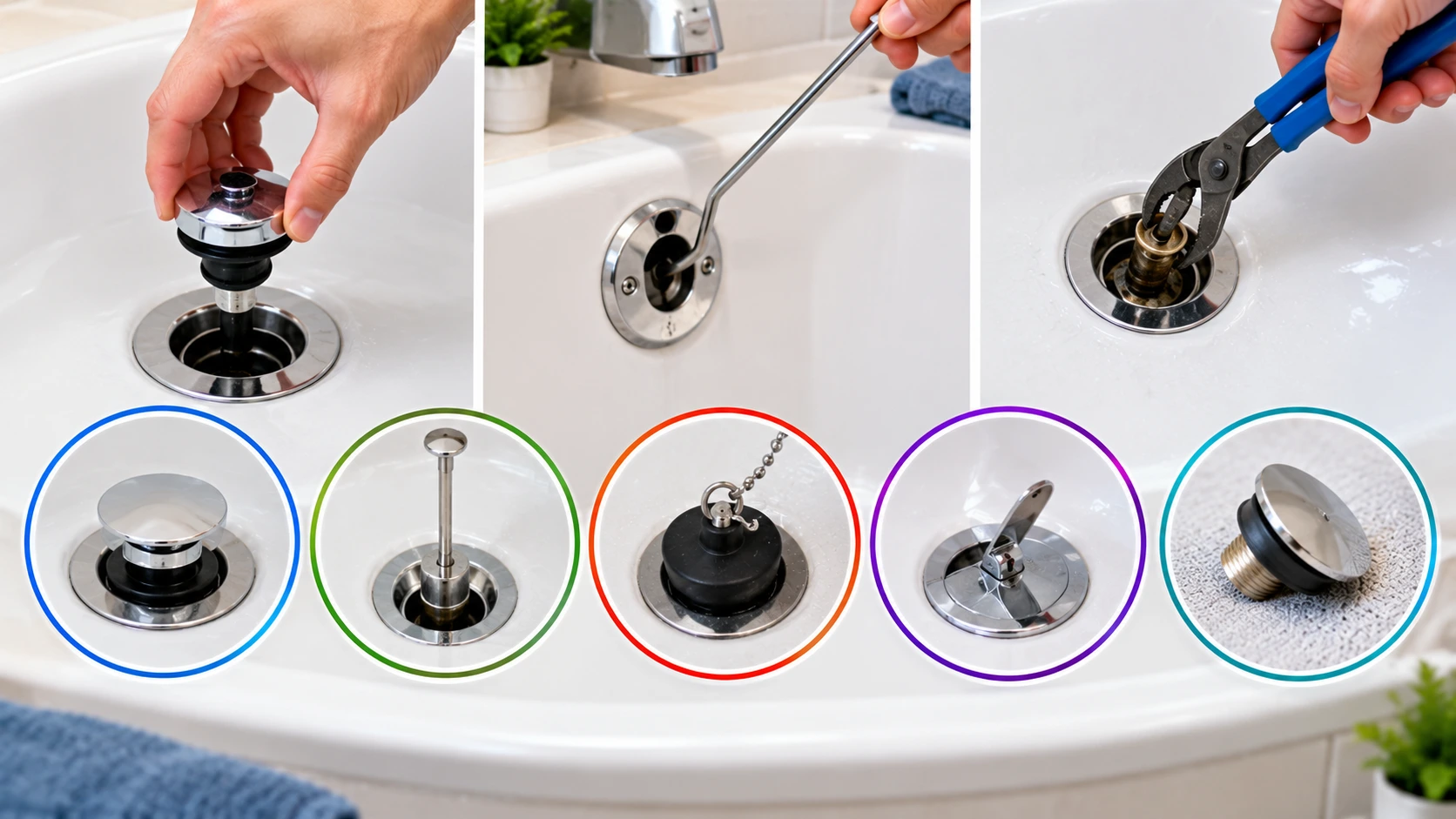
Types of Bathtub Drain Stoppers
Before you pick up a tool, take a close look at your tub. The stopper type decides every step after this one.
Push-Pull Stopper
This one has a small knob on top. You pull the knob up to let water drain and push it down to hold water. The knob sits on a threaded post that screws into a crossbar inside the drain. It is one of the most common stoppers in newer bathrooms.
Lift-and-Turn Stopper
It looks a lot like a push-pull stopper. The difference is that you lift the knob and then twist it to lock it open or closed. Many lift-and-turn stoppers have a tiny set screw on the side of the knob, and that screw is the reason people get stuck.
Trip-Lever Stopper
Look at the round plate under your faucet. That is the overflow plate. If it has a small lever you flip up and down, you have a trip-lever system. In the most common version, there is no stopper in the drain at all, just a strainer. A brass plunger inside the overflow pipe drops down to block the water.
Toe-Touch Stopper
A spring-loaded stopper. You press it with your toe to close it and press again to open it. There is no lever and nothing to lift. It is easy to use, but the spring inside collects hair fast.
Pop-Up Stopper
This one also works with a lever on the overflow plate, but here you can see a metal stopper in the drain. When you flip the lever, the stopper pops up. Under the stopper is a curved metal piece called a rocker arm that connects it to the lever.
Field Note: Not sure which one you have? Check the overflow plate first. If it has a lever, you have a trip lever or pop-up stopper. If the plate is plain, the stopper works on its own, so it is a push-pull, lift-and-turn, or toe-touch.
How to Remove a Push-Pull Bathtub Drain Stopper?
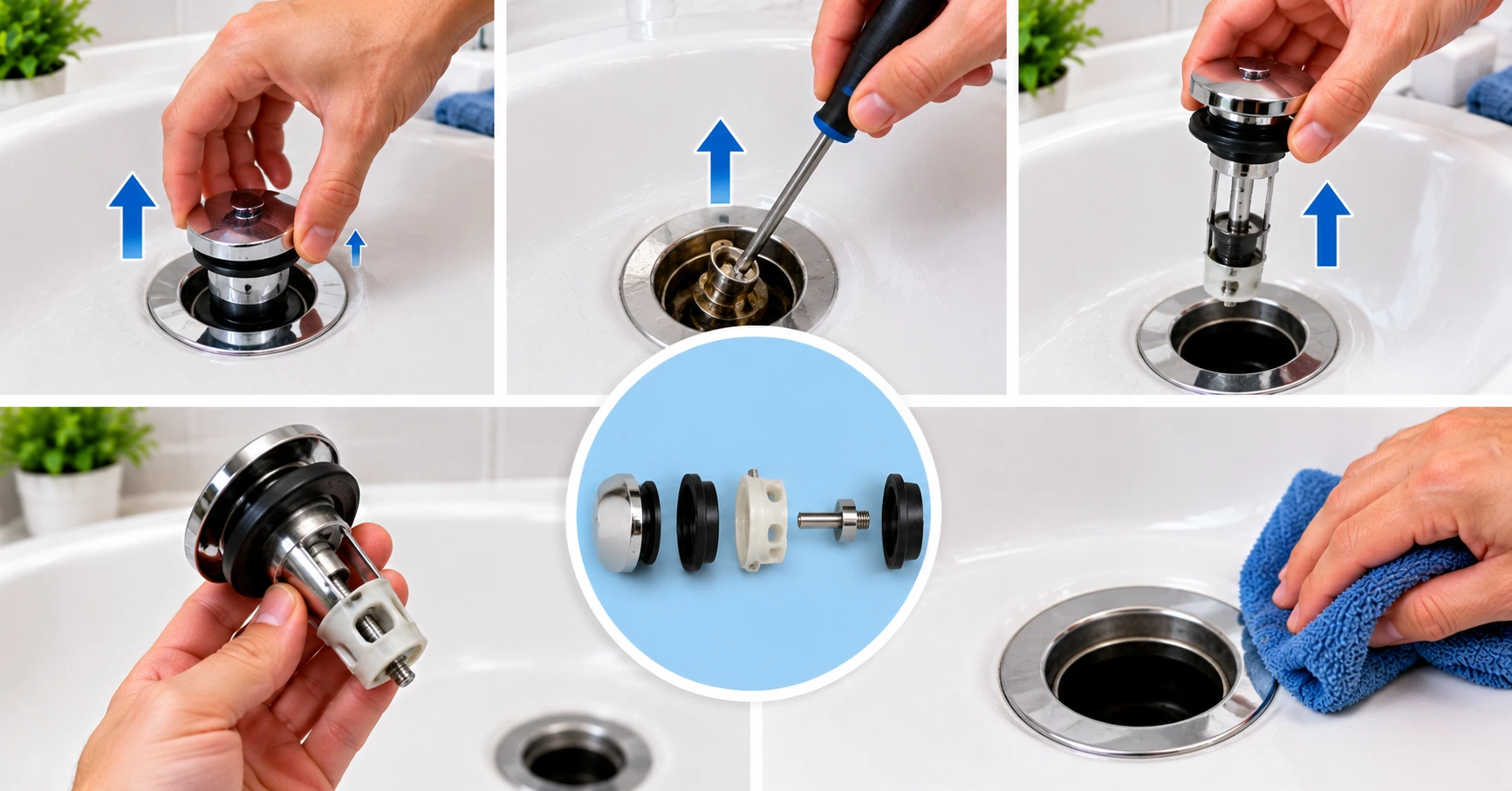
This is usually the easiest one. Plan for five minutes.
- Pull the knob up so the stopper is in the open position.
- Hold the stopper body still with one hand. With the other hand, turn the knob counterclockwise until it unscrews.
- If the knob will not turn, wrap a rag around it and grip it with pliers. The rag keeps the pliers from scratching the finish.
- With the knob off, turn the whole stopper counterclockwise. It will unscrew from the threaded post. Some models simply lift straight out at this point.
- If a post is still sitting in the crossbar, unscrew it with a flathead screwdriver or pliers.
- Pull out the hair and gunk from the stopper, the post, and the drain opening. To put it back, do the same steps in reverse.
Have a toe-touch stopper? The steps are almost the same. Put it in the open position, unscrew the top cap counterclockwise by hand, and then use a screwdriver to unscrew the body underneath. Some toe-touch models have a small screw under the cap that you need to take out first.
Field Notes: Most push-pull stoppers we take out in Gwinnett County homes have a thick rope of hair wrapped around the post. If your tub was draining slowly, that hair is often the whole problem. If some of it is deeper than you can reach, the same barbed plastic tool we recommend for unclogging a shower drain works in a tub too.
How to Remove a Lift-and-Turn Bathtub Drain Stopper?
The only tricky part here is the set screw. Find it, and the rest is simple.
- Lift the knob and twist it so the stopper is open.
- Look closely at the knob with a flashlight. Check the side and the top for a small set screw. On some models, it hides under a little cap that pops off.
- If you find a set screw, loosen it a few turns with an Allen key or a small flathead screwdriver. You do not need to take it all the way out. Then lift the stopper off the post.
- If there is no set screw, hold the stopper and turn it counterclockwise until it comes off.
- Unscrew the post from the crossbar with a screwdriver.
- Clean everything and put it back in reverse order.
One tip from experience: put a rag over the drain opening before you touch that set screw. Drop it down the drain, and you will be fishing for it for a long time.
How to Remove a Trip-Lever Bathtub Drain Stopper?
Trip-lever stoppers work from the overflow, not the drain. That is why so many people get frustrated with them. They keep trying to pull something out of the drain that is not there. If you are searching for how to remove tub drain stopper parts on an older tub, this is the type you most likely have.
- Place a towel in the bathtub. It is going to protect your bathtub from getting scratched and will catch debris.
- With the help of a flathead or Phillips screwdriver, unscrew the two screws holding the overflow plate.
- Gently pull the plate off. In the process, the lever with its metal linkage is going to follow. Continue pulling the lever until the whole linkage is removed; it is much longer than you think. It is going to have a brass plunger or spring in its bottom part.
- If you have a pop-up stopper on the drain, it is going to be in the drain as well. Rotate the lever to the opening position, take the stopper and lift it gently, rocking. The rocker arm beneath the stopper is going to follow.
- Remove hair from the plunger, spring or rocker arm, since most trip-lever clogs are trapped in there.
- Next, put the linkage back to the overflow, align the plate, and put the screws on.
Levers can be adjusted before you start tightening all the components. First, check the lever for proper operation: if the bathtub doesn’t keep water in it, the linkage is too short; if the tub empties even when the lever is open, it is too long. Usually, linkages are adjustable by means of a threaded rod with a lock nut.
How to Remove a Bathtub Drain (The Drain Itself)
Sometimes taking out the stopper is not enough. The drain flange is cracked, the finish is worn off, or water is leaking under the tub. In that case, you need to remove tub drain itself. This section covers how to remove bathtub drain stopper flanges the safe way.
The drain flange is the metal ring you see in the floor of the tub. It screws into a fitting under the tub called the drain shoe. You will be unscrewing the flange from the top while the drain shoe stays in place.
What you need: a drain key (also called a drain wrench, usually $10 to $15 at a hardware store), an adjustable wrench, a utility knife, a hair dryer, and penetrating oil. No drain key? Needle-nose pliers and a large screwdriver can work.
- First, take off the stopper using the procedure for your type of drain above.
- Check your drain and see what is in it. Most drains will have a metal cross piece in an X or + shape.
- Take the drain key and put it on the crossbars. Turn counterclockwise with the wrench. If you do not have a drain key, insert needle-nose pliers into the crossbars. Place a screwdriver between the handles of the pliers and turn counterclockwise.
- If it is stuck there, then you probably have some old plumber’s putty or silicone that was left from the previous installation. You need to cut the edge with a utility knife. Apply heat with a hairdryer for 2 to 3 minutes. Spray around the edge with the penetrating oil. Wait 15 minutes and try again.
- Never replace crossbars. Crossbars are either broken or missing. In this case, use an internal drain extractor. This device removes drain from the wall of the drain and not crossbars.
- As soon as it starts loosening, turn it by hand and lift it out. Make sure that you clean the old putty from around the tub before installation of the new drain.
Important: Do not try to pry it out. Old houses can have a bent or broken drain shoe under the tub. It would mean wall or ceiling work to fix it. If heat and oil didn’t help you, stop trying and call a plumber.
When to Replace vs Just Remove a Bathtub Drain Stopper
Most of the time, you remove the stopper, clean it, and put it back. It costs nothing and takes a few minutes. But some problems mean the stopper or the drain has reached the end of its life.
| What You Notice | What to Do |
|---|---|
| Tub drains slowly, hair around the stopper | Remove and clean |
| Stopper does not hold water anymore | Replace the rubber gasket, or the whole stopper |
| Rust, corrosion, or peeling finish | Replace the stopper |
| Knob spins but will not unscrew (stripped threads) | Replace the stopper |
| Water stain on the ceiling below the tub | Replace the drain and call a plumber |
| New faucet that does not match the old stopper | Replace for a matching set |
A plug replacement kit can cost anywhere between $10 and $40. In the case of push-pull or lift-and-turn kits, most will simply screw into the existing crossbar. The problem of the leaking drain at the bottom of the tub is another story altogether. A water stain on the ceiling below the tub indicates that there is a leak at the point where the drain shoe connects to the pipe. That is a plumbing replacement job, not a DIY swap.
Once all systems are gone, you may want to perform a once-a-month cleaning with vinegar and baking soda to flush the buildup of soap film in your bathtub. It must be noted that the procedure will not eliminate hair clogs.
Frequently Asked Questions
How do I know what type of bathtub drain stopper I have?
Begin by looking for the overflow plate beneath the faucet. In some cases, there will be a lever, meaning you have a trip-lever or pop-up system. In most cases, you won’t find one. It is important to look at the stopper instead, as it can be pulled with a push-pull, lifted with a lift-and-turn, or pushed using a toe-touch stopper.
Can I remove a bathtub drain stopper without tools?
Most of the time, yes. Several types of push-pull, toe-touch, and lift-and-turn stoppers unscrew by hand. But if there is a set screw, the post is stuck, or you have a trip-lever stopper, you will need a screwdriver because the overflow plate is attached with screws.
Why won’t my bathtub drain stopper come out?
Common culprits include: hair wound around the post, mineral deposits on the threads, a set screw which is still tight, or corrosion on older metal parts. Make sure you are turning counterclockwise. Seems simple, but it actually happens far more than you think.
How do I remove a bathtub drain stopper that is stuck?
Grip the stopper with pliers and use a rag to wrap around it. If you cannot turn it, spray a few spritzes of penetrating oil on it around the base and wait 15 minutes before trying again. To help loosen soap scum, run hot water from a tap over the stopper. If you remove the stopper, but the tub still drains slowly, the clog is further down the pipe, and you may need professional clogged drain repair.
Do I need a plumber to replace a bathtub drain stopper?
Not normally. Fortunately, removing the stopper is a quick DIY project most owners can do at home. Contact your plumber if the drain flange doesn’t come out, reveals leaks under the tub or the drain shoe is fractured. These repair projects typically require access from below and can bring water damage if not done properly. Our team handles plumbing repairs like these every day.
Stuck Stopper or Slow Tub? Call The Plumb Hero
The Plumb Hero is a family-owned plumbing company based in Norcross, Georgia, with licensed master plumbers serving Gwinnett County and Metro Atlanta. If your stopper will not budge, your drain is leaking, or your tub still drains slowly after cleaning, we can help. We diagnose the problem first, give you a price before any work starts, and back our work with a written warranty. We also offer full drain cleaning services for clogs that sit deeper in the line.
- Phone: (470) 602-9246
- Location: Norcross, GA 30093
- Service Area: Metro Atlanta and Gwinnett County
Call (470) 602-9246 or request service online.