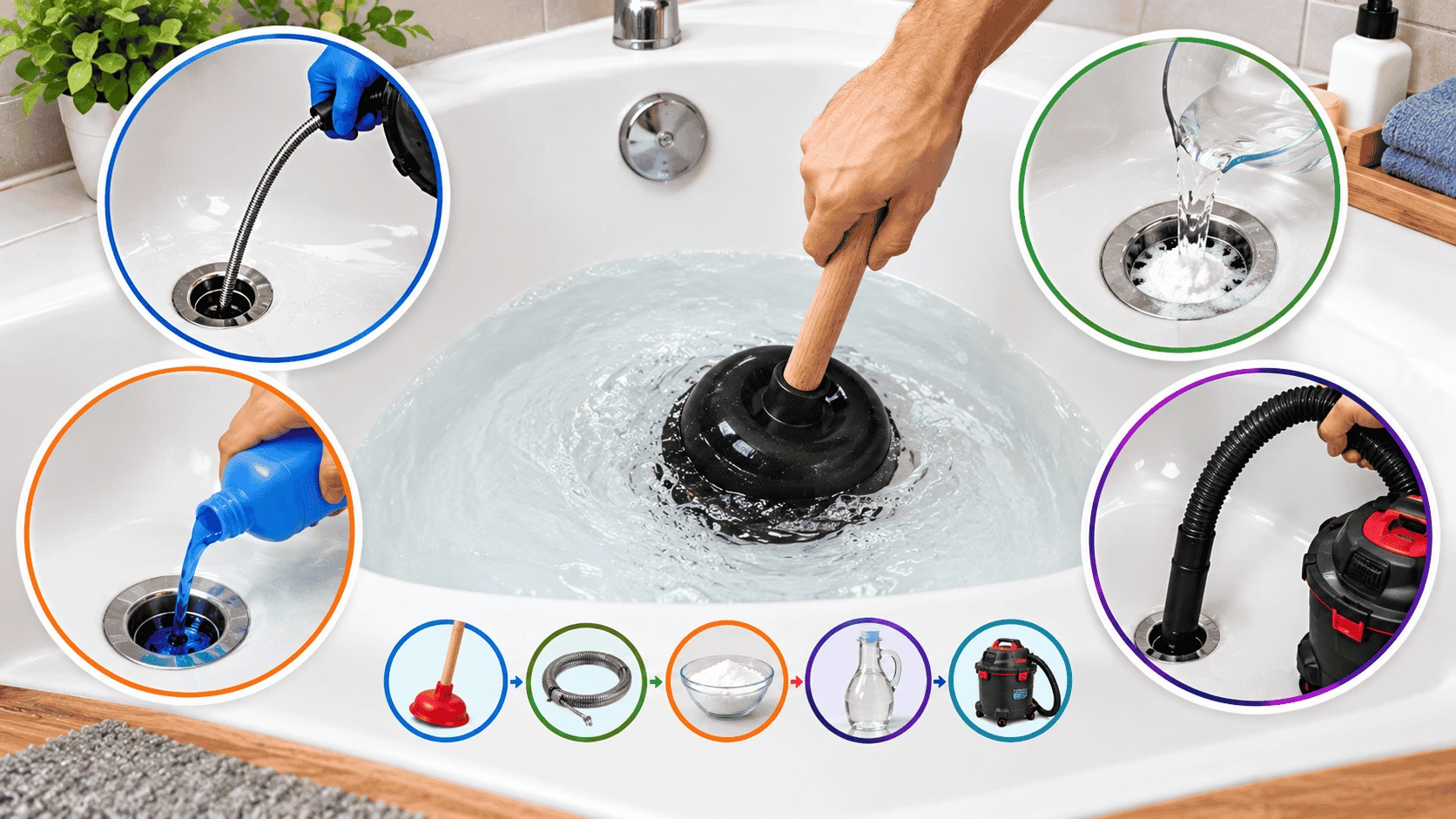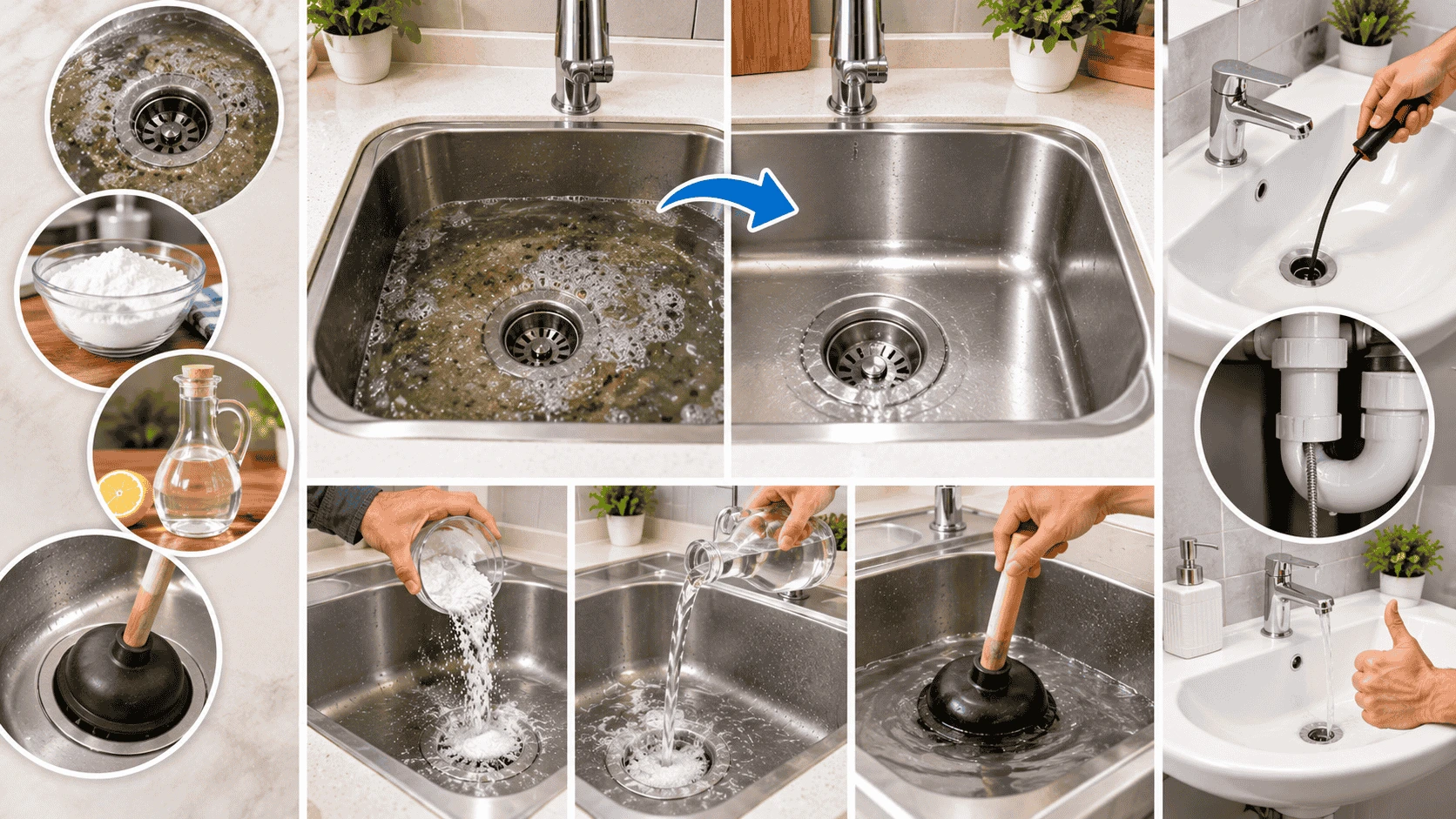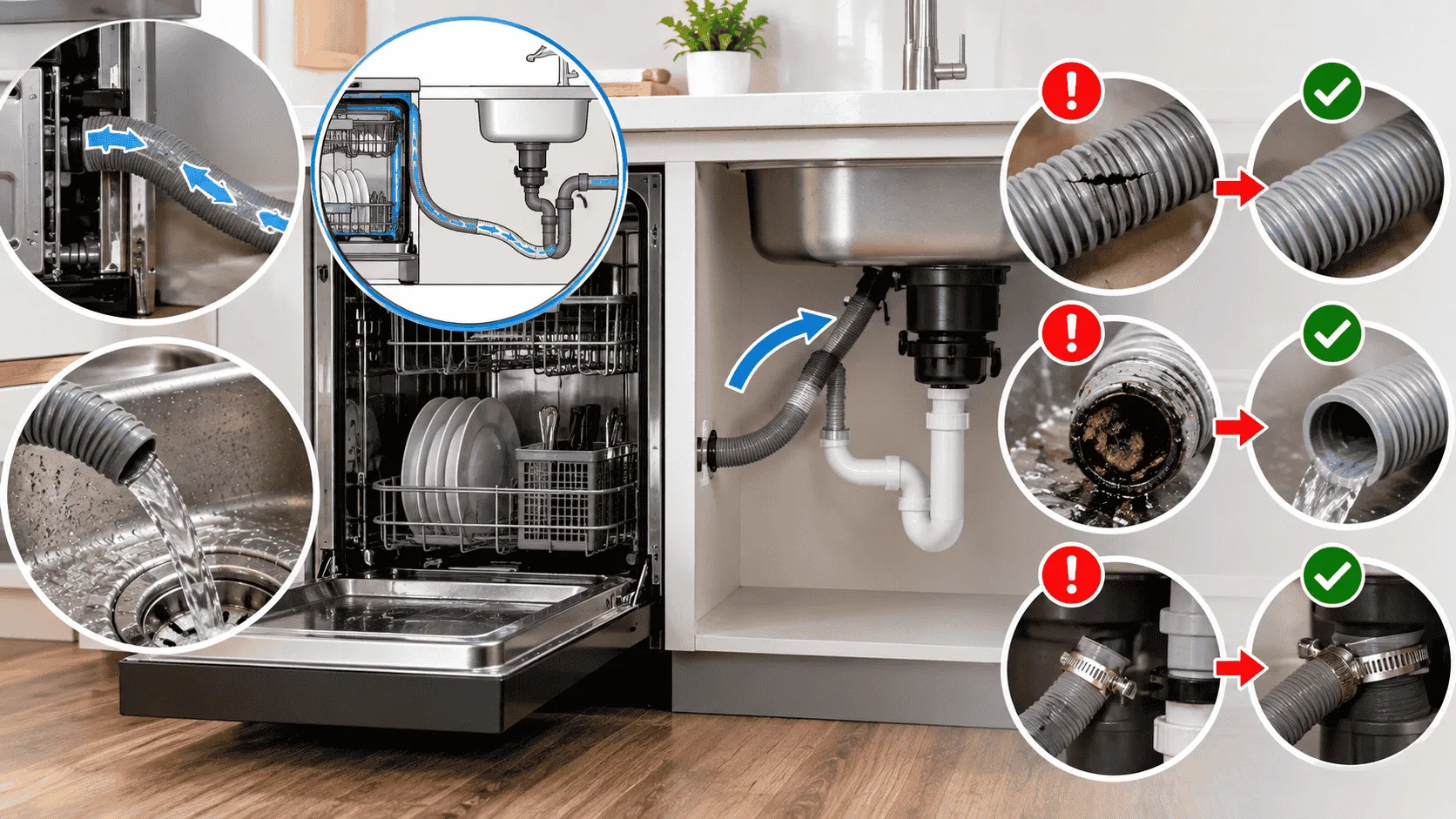



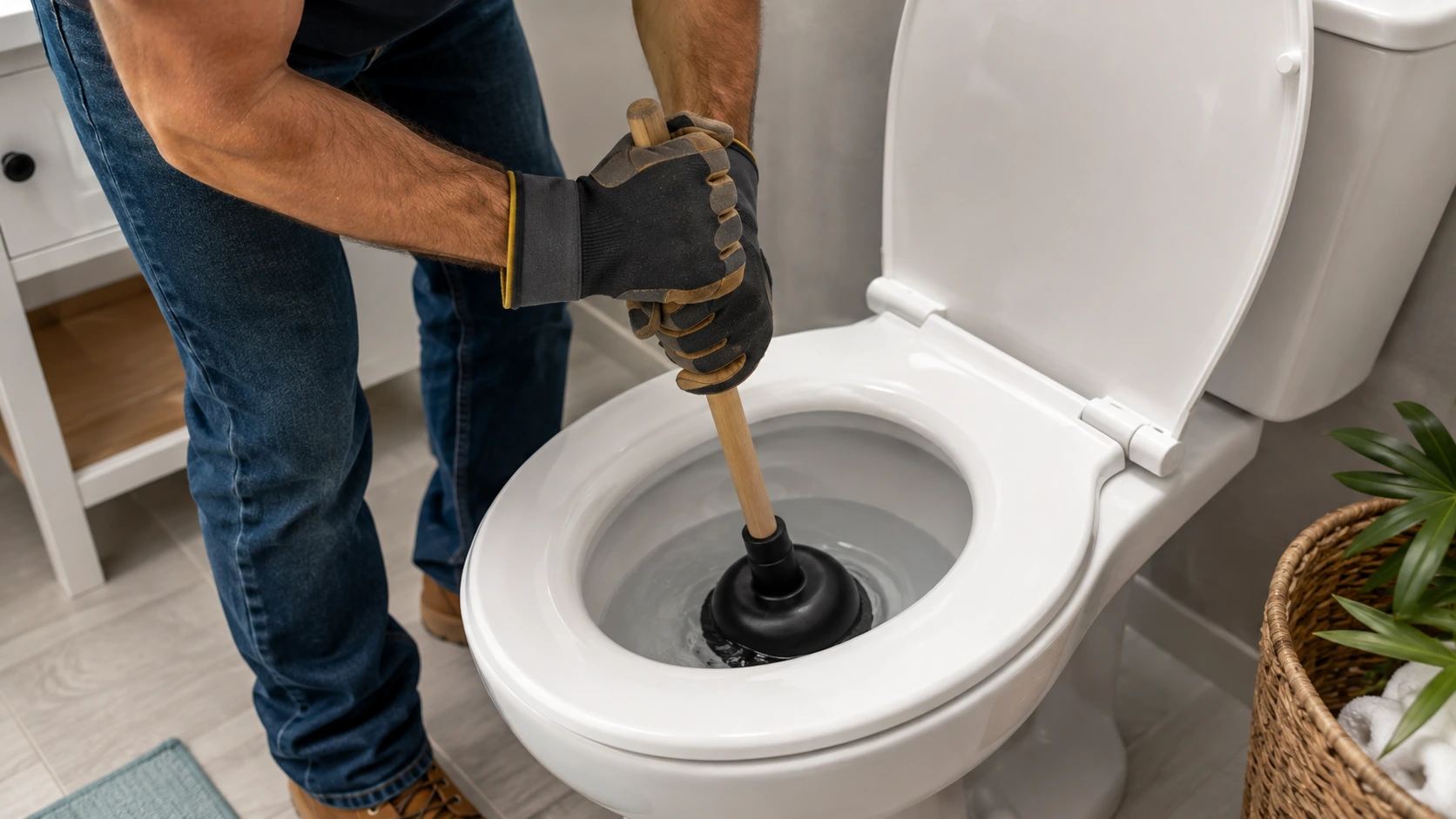
The best way to unclog a toilet is to use a flange plunger properly. It clears about 90 per cent of toilet clogs in less than five minutes, without any chemicals.
If it doesn’t work, or you need to clear the clog deeper in the drain, a toilet auger is the best option. I listed the other methods in case you don’t have professional equipment available.
Just follow this list step-by-step. Most homeowners give up on plunging too soon.
Quick Emergency Action (Stop the Water First):
Don’t flush again if you have an overflowing toilet, because you will make matters worse. You can close the toilet by lifting the tank lid and pressing down on the rubber flap, or by turning off the toilet’s water supply valve.
Emergency Protocol: 3 Steps to Stop an Overflow & Prep Your Workspace
Do this in the first 30 seconds, before you try anything else:
- Do not flush again. A blocked bowl overflows on the second flush. If water is rising toward the rim, act immediately.
- Open the tank and push the flapper down. The flapper is the rubber seal at the bottom of the tank. Pressing it closed stops water from entering the bowl immediately.
- Turn off the supply valve. Reach behind the toilet near the floor and turn the handle clockwise until it stops. The tank will no longer refill.
- Lay towels around the base. Old towels contain spills and save your flooring.
Stop the Spill First: Emergency Shutdown & Workspace Prep
- Rubber gloves
- Flange plunger
- Old towels
- A bucket
- Disinfectant spray for afterwards
Add a toilet auger to that list if the plunger fails. They run $20 to $50 at hardware stores.
First Response: How to Stop a Toilet Overflow & Prep for Unclogging
The amount of water in the bowl decides which method works:
- Bowl nearly full: Bail some out with a plastic cup into a bucket until the bowl is roughly half full. A full bowl splashes the moment you plunge.
- Bowl half full: This is the target. Move straight to plunging.
- Bowl nearly empty or dry: Add water from a bucket until the plunger head sits fully submerged. Plunging a dry bowl pushes air and accomplishes nothing.
Method 1: The Plunger (How to Unclog a Toilet With a Plunger)
The right tool and technique both matter when learning how to unclog a toilet properly.
Use a flange plunger.
The flanged plunger has a rubber extension from the base of the cup that extends into the toilet drain hole to create a seal. The flat-cup plunger is for flat sinks and will not create a seal in a curved toilet bowl.
To make the rubber more pliable, soak the plunger head in hot tap water for about 30 seconds before plunging. Warmed rubber forms a better seal on the porcelain than cold rubber.
How to plunge correctly?
- Place the flange inside the drainage hole in the bottom part of the toilet bowl.
- Apply gentle pressure the first time to expel air trapped in the cup without splashing.
- Squeeze with steady strokes, but maintain the seal throughout.
- Pulling is as important as pushing; pulling releases a clog, while pushing tends to compact it.
- Do 20 pumps at a time, then rest to see whether the water level decreases.
Method 2: Toilet Auger
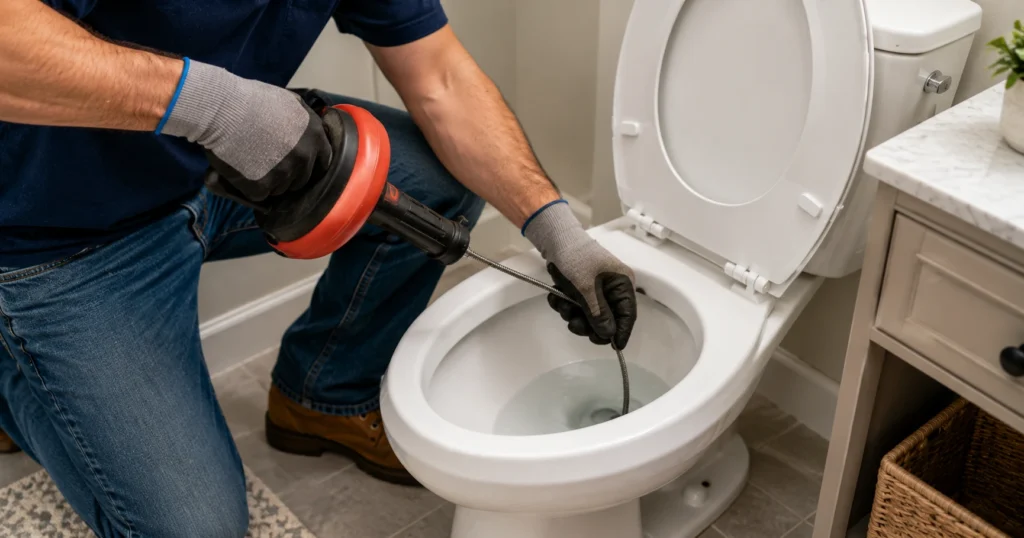
Also called a closet auger, a toilet auger features a flexible cable inside a rigid tube with a curved protective end. Use it when plunging fails or when you know a solid object went down the trap.
- Place the curved rubber shoe into the bowl outlet and hold the tube steady.
- Push the cable forward while turning the crank handle clockwise.
- Stop pushing when you feel resistance; that is the clog.
- Keep cranking so the tip either bores through or hooks the object.
- Retract slowly with steady clockwise rotation.
Buy an auger with a protective plastic or rubber shoe to prevent metal from permanently scratching the porcelain.
Method 3: Dish Soap and Hot Water (How to Unclog a Toilet Without a Plunger)
If you don’t have those materials, the best way to unclog a toilet is to mix liquid dish soap with hot water. The soap acts as a lubricant in the porcelain trap, helping move the blockage out smoothly.
- Pour half a cup of liquid dish soap directly into the bowl to lubricate the trap walls.
- Wait 15 to 20 minutes for it to sink and coat the blockage.
- Heat a gallon of water until hot (use hot tap water, never boiling water).
- Pour the water into the bowl from waist height to add downward force.
- Wait another 10 to 15 minutes before testing.
Method 4: The Bucket Pour
The Bucket Pour. Use a bucket containing two gallons of warm water. Pour the first half gallon carefully to see if the bowl accepts it, then pour the remaining portion quickly, directly into the drain opening from waist level. The sudden volume of water creates hydraulic pressure that removes any clog causing weak flushes.
Method 5: Wet/Dry Shop Vacuum
If your child’s toy or another tough object gets stuck in the trapway, the best way to unblock the toilet is not to force it further in, but to pull it out with a wet/dry shop vacuum.
- Switch the vacuum to the wet setting and remove the paper filter.
- Clean up any water inside the bowl.
- Cover the vacuum nozzle end with an old towel for a snug fit inside the drain.
- Activate the vacuum to pull the obstruction into the tank.
Method 6: Enzyme Treatment Overnight
Enzymatic drain cleaner can liquefy organic matter, paper, and grease without damaging the pipes. Pour the recommended amount into the toilet and let it work overnight. Enzymes take a long time to work and cannot liquefy plastic toys.
Alternative Clog Hacks Evaluated (And What Never to Try)
- Baking Soda and White Vinegar: A mixture of one cup of baking soda and two cups of white vinegar will bubble and help break up light deposits, but not heavy clogs.
- Unwrapped wire coat hanger: Effective in clearing shallow obstruction but has a risk of scratching the porcelain material.
- Wrap the bowl with plastic wrap: Sometimes effective but messy if not sealed properly.
- Toilet brush: Used to clear very light surface blockage in the toilet bowl.
DIY Toilet Hacks: What Works, What Fails, and What Ruins Your Toilet
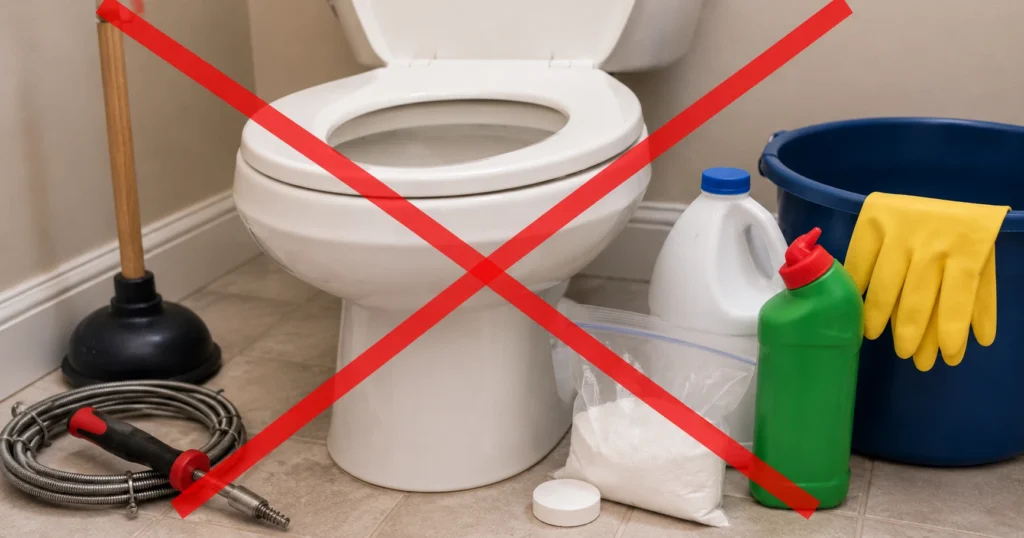
- Can you use Drano in a toilet: NO! Do NOT use Drano or chemical drain cleaners in a toilet! When a chemical reaction occurs, it releases heat that can destroy wax rings and crack porcelain, leaving additional standing water if the clog remains.
- Sudden temperature rises: Thermal shock can crack the porcelain bowl.
- Flushes repeatedly: It flushes more water into a clogged bowl to ensure the water flows over.
Is It the Toilet, or Is It Your Drain Line?
- Toilet only problem: It’s a problem with only one toilet, and all other sinks, tubs, and showers are fine.
- Main drain line issue: Water backs up in the shower when you flush the toilet, sinks gurgle, or multiple fixtures slow down at the same time. Do not use plunging for a main drain line backup.
Click here to know more about main sewer line clog signs and fixes.
What a Plumber Charges to Unclog a Toilet
If you are unable to get your clog out, knowing the cost to unclog a toilet can help you budget:
- Routine toilet clearing (auger): $100 – $275
- Clearing requiring toilet pull and reset: $200 to $450
- Main line clearing: $200 to $500+
Why Chronic Clogs Happen (And Why the Best Way to Unclog a Toilet Isn’t Always a Plunger)
A toilet clogging once is an incident. A toilet clogging every few weeks has a cause.
Wipes, including flushable ones. They do not break down. Toilet paper disintegrates within minutes. Wipes hold their shape, catch on the trap, and accumulate.
A weak low-flow toilet. Early 1990s models cut water volume without redesigning the bowl or trap. Some never flushed reliably. Modern 1.28-gallon toilets move waste far better than a 1994 1.6-gallon unit.
A partially blocked branch or main line. The most common cause of a chronic clog, and the one no amount of plunging addresses.
A blocked vent stack. Drains need air to flow. A vent obstructed by a nest or debris causes slow drainage and gurgling across several fixtures.
Mineral buildup in the rim jets. Hard water deposits close the small holes under the rim, weakening the flush. Clearing them with a descaler restores flush power.
Two or three clogs in a month justifies a camera inspection rather than another plunger cycle.
Proactive Plumbing: 7 Simple Rules to Prevent Future Toilet Clogs
A few simple habit changes can stop most clogs before they start:
- Use the toilet only for urine, faeces, and toilet paper: No wet wipes, even if they are “flushable,” tampons, paper towels, or floss.
- Keep a covered trash can nearby. Make non-flushable disposal easy and obvious for family and guests.
- Reduce paper usage. Use less toilet paper per flush, or split heavy loads into two flushes.
- Descale rim jets twice a year. Hard water mineral buildup in the small jet holes under the rim weakens your flush power. Soak them with a descaling solution to keep the flush strong.
- Educate children and keep the tank lid clear. Teach kids what belongs in the toilet and keep toys out of the bathroom. Avoid placing items on the tank lid where they can fall into the bowl.
- Upgrade older fixtures: Old toilets that require more water to flush can be upgraded to new, efficient models that use just 1.28 gallons and cost much less over time than ongoing plumbing service calls.
- Install monthly enzyme cleaners: For toilets with slow drainage, use an enzyme cleaner each month to prevent organic buildup in the trap.
Clogged Toilet Repair in Norcross and Metro Atlanta: The Plumb Hero Difference
When DIY plunging and home augers fail, or you need the best way to unclog a toilet, you need a local plumbing team that can diagnose the exact cause of the blockage instead of applying a temporary quick fix.
The Plumb Hero provides fast, reliable, and comprehensive clogged toilet and drain clearing services for homeowners in Norcross and across the Metro Atlanta area.
Comprehensive Service & Local Expertise
The Plumb Hero covers all problems, from individual toilet trap stoppages to sewer main stoppages in Norcross, Duluth, Alpharetta, Johns Creek, Marietta, Decatur, Sandy Springs, and Buford.
Many older homes built before 1980 in neighbourhoods around Gwinnett and North Fulton may have old clay or cast iron sewer lines that can develop problems like tree roots, sagging, and scaling. In these homes, clogged toilets or overflows usually indicate a problem in the sewer line, not the bowl.
What to Expect When You Work With The Plumb Hero
- Upfront Inspection and Transparent Pricing: Our Plumb Hero plumbers never make assumptions. We inspect the toilet system to see whether the problem is limited to the fixture or extends into the branch lines so that we can give you an accurate quote.
- Advanced Clearing Technology: Using commercial closet augers, high-definition sewer video camera inspection scopes, and hydro-jetting devices, our expert staff can safely identify and remove any blockage without damaging your porcelain or plumbing pipes.
- Fixture Removal and Resetting: If a solid object is stuck deep inside the porcelain trap, our experts will pull the fixture, clear the blockage, install a new wax ring seal, and reset your toilet so there’s no risk of sewer gas leaks.
Please call us now or schedule your drain clearing appointment in Norcross and Metro Atlanta at The Plumb Hero by calling (470) 602-9246 or visiting our head office at 6089 Oakbrook Pkwy, Norcross, GA 30093.
Frequently Asked Questions
What is the best way to unclog a toilet?
Use a flange plunger used correctly. Bail or add water until the bowl is about half full, seat the flange in the drain opening, press the first stroke slowly to expel air, then pump with equal force on the push and pull for about 20 strokes. Keep at it for five to ten minutes before switching methods. This clears most household toilet clogs.
How do I unclog a toilet without a plunger?
Pour half a cup of soap into the bucket, let it sit for 15-20 minutes, then pour in a gallon of hot (not boiling) water from about waist height. Let it sit for an additional 10 minutes, then check. A bucket of two gallons of water poured rapidly can do the trick alone, and a wet/dry shop vacuum removes the clog altogether if you have one.
My plunger is not working. What should I try next?
Auger for a toilet. Plungers use water pressure against the blockage, so they don’t work for solid objects or clogs beyond the trap. The auger inserts a cable into the pipe, which either cuts through the blockage or grabs it to pull it out. An auger costs 20-50.
How do I unclog a toilet with no water in the bowl?
Always add water first. Fill from a bucket until the plunger head is covered with water, then plunge as normal. Plungers use water pressure, and with an empty bowl, there is nothing but air to push.
Can I use Drano or Liquid-Plumr in a toilet?
That is also wrong because both packages say they aren’t meant for toilets. The mixture will produce heat, which will damage the wax ring underneath and older parts inside the toilet. If there is a clog and the product sticks to the toilet, the plumber will have to remove it first.
My toilet is about to overflow. What do I do right now?
Do not flush any more. Lift the cover and reach into the tank to push down the flapper and stop water from flowing into the bowl. Then find the supply valve behind the toilet and turn it clockwise until it stops. Put some towels near the toilet.
Is it safe to leave a clogged toilet overnight?
Yes, unless it is close to the rim or someone flushes it. The clog will not get worse on its own. Turn off the valve on the back of the toilet so it won’t overflow if someone flushes it by accident.
Will hot water unclog a toilet?
Hot water works well in this situation, especially after adding dishwashing liquid, since it loosens the waste and toilet paper. Never use boiling water, as it can crack the toilet bowl due to the sudden temperature change.
Why does my toilet keep clogging?
Possible causes include flushable wipes, a poorly functioning low-flow toilet that doesn’t flush well, mineral buildup blocking the rim jets, a blocked vent stack, or a partial blockage in the drain pipe. However, repeated clogging despite no abnormal waste being flushed suggests a drain pipe clog.
Are flushable wipes safe to flush?
Wrong. Toilet paper breaks down in water within minutes. Flushable wipes retain their shape, catch in pipe bends, and create clogs. Municipal sewage systems spend a lot of money to remove them.
Water backs up in my shower when I flush the toilet. Is that a toilet clog?
Not really. It’s a blockage in your drainage system or sewer line. The wastewater from your toilet can’t go anywhere but out through the nearest outlet, which is the shower drain pipe. Stop all water usage inside the house and contact a plumber.
How much does a plumber charge to unclog a toilet?
A typical clogged toilet that can be unclogged with an auger costs $ 100- $ 275. A clogged toilet, or one that needs to be pulled out and set up again, costs between $200 and $450. If the issue is the drain, it will cost between $150 and $500 to remove it.
Can I use a regular vacuum to unclog a toilet?
No. Only the wet/dry shop vacuum will work on water. Using a household vacuum will damage it and may cause electric shock. When using the shop vac, switch it to wet mode, remove the paper filter, suck up the water, seal the hose in the drain with a towel, and pull the clog back.
Does the plastic wrap trick work on a clogged toilet?
Other times, it flops spectacularly. Putting plastic wrap on top of the rim and then flushing creates pressure that pushes down on the clog. It’s the same sort of pressure but without the hassle, so use the bucket instead.
When should I stop trying and call a plumber?
Call when a plunger and an auger have both failed, when an object is stuck and will not come back out, when water backs up in other fixtures as you flush, when several drains run slow at once, or when the toilet clogs more than once or twice a month. The last three point to the drain line, which household tools cannot reach.